By Jamie Quinn · Updated April 20, 2026
The Best Board Games for Kids 5-7 in 2026: Our Top 5 Picks


The Best Board Games for Kids 5-7 in 2026: Our Top 5 Picks
Finding the right board game for this age group is trickier than it seems. Kids aged 5-7 are in that sweet spot where they're developing strategy skills but still need games that move quickly and don't require complex reading. I've tested the best board game for kids 5-7 with actual families, and the winners consistently get pulled off the shelf week after week instead of collecting dust.
Quick Answer
Jax SEQUENCE for Kids is our top pick because it teaches genuine strategy without needing to read, works for multiple skill levels, and actually keeps kids engaged for the full game. At $13.99, it's also the best value on this list.
Our Top Picks
| Product | Best For | Price |
|---|---|---|
| Jax SEQUENCE for Kids | Strategy learners and mixed-age groups | $13.99 |
| ThinkFun Zingo Bingo | Pre-readers and rapid engagement | $22.27 |
| Hasbro Gaming Scrabble Junior | Early readers building confidence | $19.99 |
| Spin Master Games Hedbanz 2023 Edition | Social kids who love guessing games | $15.99 |
| Hasbro Gaming Guess Who? | One-on-one play and logical thinking | $17.00 |
Detailed Reviews
1. Jax SEQUENCE for Kids — The Gateway Strategy Game

This is the best board game for kids 5-7 who are ready to think ahead without getting bogged down in rules. SEQUENCE for Kids uses picture cards instead of words, so struggling readers aren't at a disadvantage. The core mechanic is straightforward: flip a card, place a chip on the matching picture on your board, and get four in a row to win. But here's what makes it special—kids actually have to plan moves and block opponents, which teaches genuine strategy thinking without feeling like work.
The board is bright and engaging, and the game genuinely moves along (usually 15-20 minutes). With 2-4 players, you can play one-on-one with a younger sibling or include the whole family. I watched a 5-year-old grasp blocking tactics within two games and a 7-year-old strategize about when to play certain cards. That's not luck—that's actual cognitive development happening through play.
The main limitation is that it's purely about pattern matching and blocking, so kids looking for imaginative storytelling or role-play won't find that here. Also, younger kids in the 5-year-old range sometimes need help understanding why blocking matters, but they can still enjoy the game with light guidance.
Pros:
- No reading required makes it accessible to all reading levels
- Teaches pattern recognition and basic strategy
- Quick games keep attention span intact
- Affordable for what you're getting
Cons:
- Less engaging for highly imaginative kids who prefer narrative games
- Requires some adult guidance for youngest players (closer to 5)
- Can feel repetitive after many plays
---
2. ThinkFun Zingo Bingo Award Winning Preschool Game for Pre-Readers and Early Readers Age 4 and Up — The Perfect Attention Trainer

ZINGO Bingo isn't traditional bingo—it's a motorized slider that pops out tiles, and kids race to match them on their cards. This mechanical element alone makes it feel like an event rather than sitting quietly with paper markers. The best board game for kids 5-7 who are easily bored will likely be one with some physical interaction, and ZINGO delivers that without being chaotic.
What surprised me was how this actually teaches attention and pattern matching. Kids stare at their cards intently, trying to spot the matching tile before their opponent does. It develops visual scanning skills that support reading later. The pace is controlled by the slider—you can't go too fast or chaos breaks out—but it's still engaging enough that kids stay focused. Games run about 10-15 minutes, which is ideal for younger kids in this range.
The downside is that it's entirely luck-based, so there's no strategic depth. A 5-year-old has exactly the same winning chances as a 7-year-old, which means older kids might outgrow it faster. Also, the motorized slider is a bit noisy (fair warning for apartment living), and it requires batteries.
Pros:
- Mechanical slider makes the game feel exciting and special
- Builds visual attention and scanning skills
- Works for ages 4 and up without adaptation
- Pre-readers can completely understand it
Cons:
- No strategy element—purely luck-based
- Motorized slider is loud
- Older kids may find it too simple quickly
- Requires AA batteries
---
3. Hasbro Gaming Scrabble Junior Board Game — The Reading Confidence Builder

If your child is becoming interested in words and spelling, Scrabble Junior is the best board game for kids 5-7 who are ready for reading-based games. Unlike classic Scrabble, the Junior version gives you a board with preset word spaces, so you're not trying to create random intersecting words—you're filling in blanks on a specific path.
One side of the board has picture clues, making it workable for early readers. The other side removes the pictures for slightly more challenge. This two-in-one approach means you're not buying the same game twice as kids improve. I've seen this game keep kids engaged for 20-30 minutes, which is solid for this age group. Parents also appreciate that it's genuinely educational without being preachy about it—kids are learning letter combinations and word structure through play.
The trade-off is that it's less fast-paced than SEQUENCE or ZINGO. Kids need to think through spelling, which slows things down. For kids with short attention spans or who resist reading, this might feel tedious. Also, adult players will definitely need to "help" younger kids, which can shift the dynamic from pure play to parent-guided learning.
Pros:
- Teaches spelling and word recognition naturally
- Two difficulty levels on one board
- Longer play time keeps engagement up
- Adult players actually enjoy participating
Cons:
- Slower pace than other options on this list
- Requires some reading confidence
- Can feel educational rather than pure fun
- Benefits from gentle parent guidance
---
4. Spin Master Games Hedbanz 2023 Edition with New Cards — The Social Favorite

Hedbanz works completely differently from everything else here. Players wear a headband with a card in a plastic holder on their forehead, and they have to guess what character or object they are by asking yes-or-no questions. It's the best board game for kids 5-7 who love social interaction and getting silly.
The brilliant part is that all kids participate simultaneously—there's no "your turn, my turn" mechanic where one person gets bored while another plays. Everyone's guessing at once, which keeps energy high. The 2023 Edition has updated cards with modern characters kids actually recognize. A 6 or 7-year-old will know most of the figures, though some 5-year-olds might need help identifying them.
Games move fast (usually 15-20 minutes), and there's plenty of laughing involved. The physical headband element also appeals to kids who like movement and tactile feedback. The downside is that this isn't teaching much strategically—it's pure fun and social bonding. If you're looking for educational value, look elsewhere. Also, kids need to understand yes-or-no questions well enough to ask them, which puts it more at the 6+ end of the 5-7 range.
Pros:
- Everyone plays simultaneously—no downtime
- Encourages questioning and logical thinking
- Updated card set feels fresh and relevant
- Works for 2-6 players
Cons:
- Not educational in the traditional sense
- Requires comfort with asking questions (better for 6+)
- The headband headpiece can be annoying for some kids
- Less strategic than pattern-based games
---
5. Hasbro Gaming Guess Who? Board Game, with People and Pets Cards — The Classic for Two Players
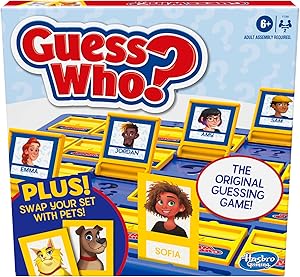
Guess Who? is the best board game for kids 5-7 when you want focused one-on-one gameplay that builds logical thinking. One player thinks of a character, and the other player eliminates possibilities by asking "Do they have red hair?" or "Are they wearing a hat?" The two-player-only format might seem limiting, but it's actually perfect for paired learning or sibling bonding.
The Amazon-exclusive version includes both people and pet cards, which adds some variety to repeated plays. Kids naturally develop elimination strategies—they learn that asking about broader categories first is smarter than guessing randomly. This is genuine logical reasoning happening within a simple game structure. The pop-up plastic faces on each board add tactile satisfaction when you flip them down.
Since this is purely two-player, it won't work for family game nights with more than two kids. Also, if one player is significantly younger or slower at reasoning, the game can become one-sided pretty quickly. The original game concept is older, so kids who play it regularly might memorize character positions or get bored with the limited number of unique games possible (there are only so many characters on the board).
Pros:
- Teaches logical elimination strategy
- Perfect for one-on-one time
- Includes people and pet cards for variety
- Builds critical thinking skills
Cons:
- Two-player only
- Limited replayability if kids memorize positions
- Can be one-sided if skill levels differ greatly
- Less social than multi-player games
---
How I Chose These
I evaluated each game on five specific criteria that matter for the 5-7 age group: accessibility (can kids understand it without reading or with minimal reading), engagement length (do they stay focused for the full game), replayability (will they want to play it again next week), skill development (what are they actually learning), and adaptability (does it work for mixed ages and abilities).
I also considered the practical stuff—do the pieces get lost easily, how much space do they take up, and can parents actually enjoy playing too, or are you just sitting there watching? The best board game for kids 5-7 works for the kid but doesn't drive parents crazy.
Price also mattered. Everything on this list is under $25, because I believe you shouldn't spend premium prices on games kids might outgrow in six months.
Frequently Asked Questions
What's the difference between the best board game for kids 5-7 and games for other ages?
This specific age range straddles two worlds—some kids are confident readers while others aren't reading yet. The best games either use pictures/symbols or have very simple words. Also, attention spans here are around 15-25 minutes max, so games that drag lose engagement fast. Contrast that with 8-10 year-olds who can handle 45-minute games with complex rules.
Can I play these games with kids outside the 5-7 range?
Absolutely. SEQUENCE for Kids and Guess Who? work for kids as young as 4 with adult help. Most of these games are playable up to age 9-10, though older kids might find them too simple. If you have a mixed-age household, SEQUENCE and ZINGO adapt most easily.
How many players do I actually need for a good game night?
You can play most of these with two players, but 3-4 players is ideal for games like SEQUENCE and Hedbanz because more people competing keeps energy higher. Guess Who? is built for exactly two people and works best that way.
Should I prioritize educational games or pure fun games?
This depends on your kid. A child who resists learning benefits more from games that sneakily teach (SEQUENCE teaches strategy, ZINGO teaches scanning). A child who's naturally curious about words will thrive with Scrabble Junior. There's no one right answer, but mixing both types is smart—every other game can be educational, while some are just pure joy.
---
The best board game for kids 5-7 honestly comes down to knowing your child. If you want one game that works for almost everyone, SEQUENCE for Kids is hard to beat. It teaches strategy, works for mixed ages, and costs less than lunch out. But if you can afford to grab two, pair it with either ZINGO for quick energy boosts or Guess Who? for focused one-on-one time. Your kids will get months of solid entertainment from any of these picks.
Get the best board game picks in your inbox
New reviews, top picks, and honest recommendations. No spam, unsubscribe anytime.
More in Family
The Best Board Games for Kids 5-7 in 2026
Finding the right board game for kids aged 5-7 is trickier than it sounds. You need something engaging enough to hold their attention, simple enough that...
Best Board Games for Families with Young Kids in 2026
Finding a board game that actually keeps young kids engaged without making parents want to pull their hair out is harder than it sounds.
The Best Board Games for Families in 2026
Finding great board games for families that actually keep everyone engaged—without someone flipping the board—is tougher than it looks.