By Jamie Quinn · Updated April 26, 2026
Best Board Games for Adults with Dementia in 2026



Best Board Games for Adults with Dementia in 2026
Finding the right activities for someone living with dementia can feel overwhelming. You want something that brings joy, keeps their mind engaged, and doesn't feel patronizing or overly simple. The best board games for adults with dementia strike a balance between accessibility and genuine fun—games that don't rely on quick memory recall but instead spark conversation, encourage participation, and create moments of connection.
Quick Answer
ThinkPsych Golden Memories - Conversation & Memory Game for Seniors is our top pick because it's specifically designed around reminiscence therapy rather than competitive gameplay. With 160 conversation topics and a format that encourages storytelling rather than "winning," it works beautifully for various stages of cognitive decline and keeps the focus on engagement and connection rather than performance.
Our Top Picks
| Product | Best For | Price | |||
|---|---|---|---|---|---|
| ThinkPsych Golden Memories - Conversation & Memory Game for Seniors \ | 160 Topics \ | Reminiscence Therapy \ | Dementia Activities for Seniors & Alzheimer Support | Conversation-based engagement and reminiscence therapy | $26.49 |
| Seenelling Jumbo Wooden Tic Tac Toe Game Dementia Activities for Alzheimers Seniors with Matching and Puzzle Templates XO Chess Board Game for Elderly Engaging Table Decor(Blue, Red) | Simple strategy without memory demands | $16.99 | |||
| Alzheimers Activities for Seniors - Memory Training Products for Dementia Elderly Wooden Gifts for Adults Patients with Dementia | Quiet, independent cognitive stimulation | $9.99 | |||
| 2nd Generation - Dementia Activities for Seniors,Wooden Alzheimers Products for Elderly,Keep Cognitive and Busy Puzzles Gifts & Games | Budget-friendly pattern recognition | $9.99 | |||
| SEQUENCE- Original SEQUENCE Game with Folding Board, Cards and Chips by Jax ( Packaging may Vary ) White, 10.3" x 8.1" x 2.31" | Accessible group play with minimal rules | $15.99 |
Detailed Reviews
1. ThinkPsych Golden Memories - Conversation & Memory Game for Seniors | 160 Topics | Reminiscence Therapy | Dementia Activities for Seniors & Alzheimer Support

This is the best board game for adults with dementia if your goal is meaningful engagement and connection rather than competitive play. Unlike traditional games that penalize mistakes or rely on intact memory, Golden Memories is built on reminiscence therapy—a clinical approach that uses conversation about past experiences to maintain cognitive function and emotional well-being.
The game includes 160 conversation topics organized by era and theme. You might discuss favorite childhood pets, memorable holidays, or important people in their life. There's no winner or loser, which removes performance anxiety and creates space for genuine storytelling. The cards act as conversation starters, and the actual "gameplay" is the dialogue itself. This works especially well in mixed-ability groups—family members of different ages and cognitive levels can all participate meaningfully.
I recommend this most strongly for people in early to mid-stage dementia who still enjoy conversation but may struggle with complex rules or competitive dynamics. It also works beautifully as a one-on-one activity between a caregiver and their loved one.
The downside is that it requires an engaged facilitator. You can't leave someone alone with this game—someone needs to read the cards, listen to answers, and keep the conversation moving. If you're looking for something your loved one can do independently, this isn't it.
Pros:
- Targets emotional and cognitive engagement simultaneously
- No "failure" possible—all answers are valid
- Clinically designed around reminiscence therapy principles
- Works across different stages of cognitive decline
- 160 unique topics provide long-term variety
Cons:
- Requires active participation from a caregiver or family member
- Not suitable for independent play
- Higher price point compared to puzzle-based options
---
2. Seenelling Jumbo Wooden Tic Tac Toe Game Dementia Activities for Alzheimers Seniors with Matching and Puzzle Templates XO Chess Board Game for Elderly Engaging Table Decor(Blue, Red)
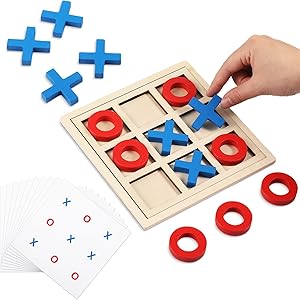
If you want the best board games for adults with dementia that keep strategic thinking alive without overwhelming complexity, this wooden tic tac toe set hits the mark. The jumbo size is crucial here—large pieces are easier to manipulate for anyone with arthritis, tremors, or reduced fine motor control. The bright blue and red colors create good visual contrast, which matters for people experiencing age-related vision changes.
What sets this apart from a standard tic tac toe board is the inclusion of matching and puzzle templates. This means the game isn't just the familiar three-in-a-row pattern; there are additional card-based challenges that modify the rules or create new objectives. This flexibility lets you adjust difficulty on the fly. If your loved one is having a sharper day, you can use the puzzle templates. On tougher days, you keep it simple.
Tic tac toe never feels condescending because it's a game almost everyone learned in childhood—there's familiarity there. The game plays in 5-10 minutes, so it doesn't demand sustained focus, and a single match doesn't feel like a major time commitment.
The honest limitation is that tic tac toe can feel repetitive quickly if played many times in succession. It's better as part of a rotation of activities rather than the only game you pull out.
Pros:
- Jumbo pieces reduce physical frustration
- High-contrast colors aid visibility
- Familiar game format feels non-threatening
- Quick play sessions work well for shorter attention spans
- Matching templates add variety
Cons:
- Can become repetitive with frequent play
- Limited strategic depth even on good cognitive days
- Puzzle templates may add unnecessary complexity for some users
---
3. Alzheimers Activities for Seniors - Memory Training Products for Dementia Elderly Wooden Gifts for Adults Patients with Dementia
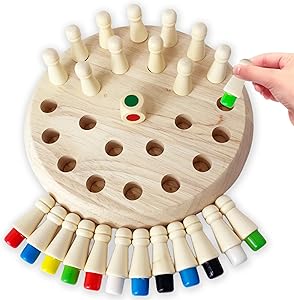
This wooden activity set is designed for independent or parallel play—your loved one can sit with this while you're nearby but not actively facilitating. It's a collection of pattern-matching and sequencing puzzles rather than a single game, which means there's built-in variety and the ability to adjust challenge level by selecting different puzzles.
The wooden construction feels substantial and tactile, which provides sensory stimulation beyond just cognitive engagement. For people who find fidgeting or having something concrete to manipulate soothing, this matters. The pieces are sized appropriately for older hands, and there are no tiny components that create frustration or choking hazards.
Because these are self-contained puzzles without competitive elements, there's no stress around "losing" or "getting it wrong." If someone puts a piece in the wrong spot, they can simply try again without judgment. This low-stakes environment is genuinely therapeutic for people experiencing the anxiety that often accompanies cognitive decline.
The trade-off is that this works best for people who still have decent fine motor control and visual perception. If someone is in advanced dementia with significant motor or perceptual decline, the puzzles may cause frustration rather than engagement.
Pros:
- Supports independent or semi-independent play
- Wooden construction is durable and pleasant to handle
- Multiple puzzle options prevent boredom
- No competitive pressure
- Affordable and excellent value
Cons:
- Requires intact fine motor skills
- Doesn't provide caregiver engagement opportunity
- Best for earlier to mid-stage dementia
---
4. 2nd Generation - Dementia Activities for Seniors,Wooden Alzheimers Products for Elderly,Keep Cognitive and Busy Puzzles Gifts & Games

This is essentially a second option in the wooden puzzle category, positioned at the budget end of the spectrum. At $9.99, it's hard to argue with the value proposition if you're looking for simple, affordable cognitive stimulation. The puzzles focus on pattern recognition and shape matching—foundational skills that remain accessible even when more complex cognition declines.
The 2nd Generation set has a stripped-down design philosophy. There aren't elaborate templates or multiple difficulty levels; it's straightforward puzzle play. This simplicity is actually a strength for people who find too many options or complex instructions overwhelming. You hand them a puzzle, they work on it, done.
This works best as part of a larger activity toolkit. If you're trying to keep someone engaged during quiet moments—while you're preparing meals, handling household tasks, or just getting through a restless afternoon—this gives them something constructive to focus on without demanding your participation or explanation.
The limitation is that it offers less variety than the Alzheimers Activities for Seniors set reviewed above. If you anticipate using this daily over months, you might find the puzzle selection limited.
Pros:
- Most affordable option on this list
- Genuinely simple—no complex rules to learn or remember
- Portable and lightweight
- Quiet activity that doesn't disturb others
- Wooden pieces feel good in hand
Cons:
- Limited variety in puzzle designs
- Less engaging for people with good cognitive function
- Minimal caregiver interaction opportunity
---
5. SEQUENCE- Original SEQUENCE Game with Folding Board, Cards and Chips by Jax ( Packaging may Vary ) White, 10.3" x 8.1" x 2.31"

SEQUENCE is interesting because it bridges the gap between traditional board games and dementia-friendly games. It's not specifically designed for cognitive decline, but it works better for people with dementia than many standard board games because the rules are straightforward and each turn follows the same pattern: draw a card, find it on the board, place a chip.
The game involves 2-12 players, which makes it excellent for group activities—family gatherings, activity groups at care facilities, or multigenerational play. The social component is actually significant. Players interact, take turns, and celebrate small wins together. There's engagement beyond just the mechanical gameplay.
The memory demand is minimal because the board displays all available cards. You never need to remember what cards have been played or what's in someone's hand—it's all visible. Strategy exists (you can plan ahead), but it's not punishing if you can't execute perfect strategy. The game naturally accommodates slower decision-making too; there's no timer, no pressure to move fast.
Play typically takes 20-30 minutes depending on player count, which is long enough to feel like a complete activity but not so long that sustained attention becomes overwhelming. The folding board makes storage and transport simple.
The main limitation is that SEQUENCE still involves "winning" and "losing," which can create anxiety for some people. If your loved one is very sensitive to competition or experiences frustration with loss, you might want a fully non-competitive option instead.
Pros:
- Simple, repeatable turn structure
- Minimal memory demand
- Great for group play and family involvement
- All information visible on the board
- Moderate play time with good pacing
- Affordable for the quality
Cons:
- Still involves competitive elements
- May frustrate people sensitive to losing
- Requires coordination of larger player groups
- Not suitable for advanced dementia stages
---
How I Chose These
I evaluated these games across five key dimensions that matter specifically for dementia care: accessibility (physical and cognitive), independence vs. facilitation requirements, emotional safety, engagement quality, and versatility across different stages of decline.
I prioritized options that don't punish mistakes, minimize reliance on working memory, and include clear sensory feedback. I also considered whether each game works for solo play, one-on-one caregiver activity, or group settings, because real-world dementia care involves different scenarios.
I specifically excluded games requiring rapid decision-making, extensive rule retention, or high physical dexterity. I also weighted price-to-value, since many families already carry significant financial burden from dementia care. The goal was to include options across the budget spectrum while maintaining quality standards.
Frequently Asked Questions
Are these games actually good for cognitive function, or just distracting?
Some are genuinely cognitively stimulating (the wooden puzzles, SEQUENCE), while others prioritize emotional engagement and connection over cognitive challenge (Golden Memories). This is intentional—for mid-stage dementia, the conversation and connection matter more than pushing cognitive capacity. However, earlier-stage dementia benefits from games with genuine strategic thinking like SEQUENCE or the puzzle sets.
What if my loved one refuses to play games?
Start with low-pressure activities like the wooden puzzles, which feel like a task rather than "playing a game." Some people respond better to that framing. You can also integrate game elements into existing activities—playing tic tac toe while having morning coffee, for instance. Never force it; forcing creates negative associations.
Can multiple people play these games together?
Yes—Golden Memories and SEQUENCE are explicitly designed for groups. The wooden puzzles work better solo or one-on-one. Mixing participants of different cognitive levels generally works as long as you don't emphasize competition or time pressure.
How often should we play?
Daily engagement is ideal, but it doesn't have to be long. 15-20 minute sessions are often better than longer stretches. Rotate between different games to maintain novelty and prevent boredom. The goal is consistent, low-stress cognitive and emotional engagement rather than intensive sessions.
---
Finding the best board games for adults with dementia depends on your specific situation—the person's current cognitive level, physical capabilities, and what kind of engagement works best for them. Start with the ThinkPsych Golden Memories if connection and conversation matter most, or grab one of the wooden puzzle sets if your loved one prefers independent activity. Either way, the goal is keeping them engaged, safe, and included.
Get the best board game picks in your inbox
New reviews, top picks, and honest recommendations. No spam, unsubscribe anytime.