By Jamie Quinn · Updated April 8, 2026
Best European Board Games in 2026: Five Classics That Actually Deliver


Best European Board Games in 2026: Five Classics That Actually Deliver
Finding a genuinely great board game that works for your group is harder than it should be. Most games either bore you halfway through or require an engineering degree to understand the rules. After years of hosting game nights and testing dozens of titles, I've landed on five European-designed games that actually hold up—games with elegant mechanics, real strategic depth, and the kind of replayability that keeps people coming back.
Quick Answer
CATAN Board Game (6th Edition) is the best European board game for most people because it combines accessible rules with meaningful strategic choices, plays well with 3-4 people, and creates the kind of competitive tension that makes game night memorable. If you want something quicker or more specialized for two players, the other options below are genuinely better for their specific purposes.
Our Top Picks
| Product | Best For | Price |
|---|---|---|
| CATAN Board Game (6th Edition) | All-around excellence and groups of 3-4 | $43.99 |
| Azul Board Game | Quick games with stunning aesthetics | $34.39 |
| Ticket to Ride Europe Board Game | Family play with 2-5 people | $51.99 |
| Targi | Dedicated two-player strategy | $22.92 |
| Lost Cities Card Game | Portable, fast-paced competition | $19.95 |
Detailed Reviews
1. CATAN Board Game (6th Edition) — The Strategic Foundation

CATAN isn't just the best European board game by sales numbers—it's the best by design. The game forces you to balance resource management with negotiation. You're rolling dice to determine which resources come available, then deciding whether to build settlements, cities, or roads. The catch? You're constantly negotiating trades with opponents, and every decision someone else makes affects your strategy.
What makes this the strongest pick for most groups is how it handles unpredictability without making it feel unfair. The robber mechanic lets skilled players block opponents, but it requires political capital to avoid everyone hating you. Games run 60-90 minutes with 3-4 players, long enough to feel substantial but short enough that losing doesn't sting for weeks. The 6th edition components are solid—the resource tokens feel substantial, the roads and settlements snap in satisfyingly, and the board tile system means no two games play identically.
The main trade-off: with five players, the game can drag. Downtime between turns multiplies, and the balance shifts toward luck over strategy. Stick with 3-4 for the optimal experience.
Pros:
- Creates genuine negotiation and table dynamics
- Rewards forward planning but stays flexible enough for surprises
- Plays differently every game thanks to modular board setup
- Perfect gateway into strategy gaming without being a "gateway" game
Cons:
- Five-player games lose momentum
- Dice rolls can feel frustrating if you're unlucky
- Takes 60-90 minutes, so not a quick option
---
2. Azul Board Game — Award-Winning Tile-Placement Strategy Game, Beautiful Mosaic Art, Family Fun for Kids & Adults, Ages 8+, 2-4 Players, 30-45 Minute Playtime
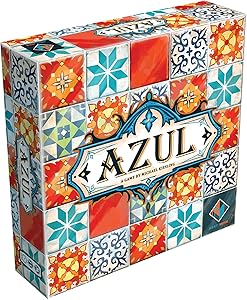
This is what happens when a designer obsesses over elegance. Azul takes a single, brilliant idea—you pick tiles from a central display, but you're forced to take all tiles of one color, which can fill your racks and create cascading consequences—and executes it flawlessly.
The game plays in 30-45 minutes, making it the perfect opener for a game night or the palate cleanser between heavier games. Each turn takes seconds. You're choosing between immediate gain and setting yourself up for the next round. The visual design is stunning enough that non-gamers actually want to play it, which is rare for a genuinely strategic game. I've had friends who typically avoid board games ask to play Azul again.
Where Azul stumbles is player count. With two players, the game becomes almost puzzle-like—very precise but less negotiation. With four players, someone always feels blocked out of key tile selections. Three players is the sweet spot, though two-player works fine if you enjoy tighter, more mathematical gameplay.
Pros:
- Teaches strategy and forward-thinking in 30 minutes
- Beautiful components that justify the game sitting on a shelf
- Low rules overhead means new players understand it immediately
- Multiple plays reveal new strategies
Cons:
- With four players, some turns feel like limited options
- Can feel repetitive after 10-15 plays
- Not enough interaction for people who love negotiation games
---
3. Asmodee Ticket to Ride Europe Board Game — a Railway Adventure Across the Continent! Fun Family Strategy Game for Kids & Adults, Ages 8+, 2-5 Players, 30-60 Min Playtime

Ticket to Ride Europe is proof that the best European board game doesn't need complicated mechanics. The premise is straightforward: collect colored train cards, claim routes between European cities, and complete destination tickets for points. But the elegance comes from the tension between going for easy routes now versus blocking opponents while pursuing difficult point-scoring routes.
This game scales beautifully across player counts. With two players, it becomes head-to-head route blocking. With five players, there's glorious chaos where someone's masterplan gets disrupted by a clever move from a player who was supposed to be behind. The Europe map is genuinely interesting—it's more compact than the original US version, forcing tighter decisions about which routes matter most.
Teach time is under five minutes. Actual play time ranges 30-60 minutes depending on player familiarity. The cards have excellent readability, and the map is clear enough that newer players don't spend turns squinting. If your group includes reluctant gamers, this is the game that converts them.
The downside: if you've played 20+ games, the strategy flattens. Once you understand optimal play, some games feel predetermined. It's not shallow—it's just that mastery comes relatively quickly.
Pros:
- Plays well with any player count from 2-5
- Fast to learn, satisfying to play
- Scales difficulty naturally with experience
- Great for mixed skill levels in a group
Cons:
- Optimal strategy becomes apparent after many plays
- Luck of the draw (which routes are available) matters more than some strategy fans prefer
- Less depth than heavier strategy games
---
4. Thames & Kosmos | Targi | Two Player Game | Strategy Board Game | Golden Geek Award Nominee | Kennerspiel Des Jahres Award Finalist

Targi is designed explicitly for two players, and it shows. The board is a grid where you place your caravan tokens in rows and columns. Where your pieces land determines which cards you can access. But here's the genius part: your opponent's caravan positions block you from certain options, forcing constant adaptation and creating this delicious tension where every placement matters.
This is the best European board game if you're a couple looking for something more substantial than Azul but quicker than CATAN. Games run 45-60 minutes. The rulebook is dense (it's design-heavy), but once you've played one round, everything clicks. The expansion market goods system creates long-term planning opportunities. You're not just collecting cards—you're building toward specific combinations that trigger bonuses.
The learning curve is steeper than other games on this list. New players often feel like they don't understand the game until turn five or six. But once it clicks, Targi delivers strategic depth that holds up across dozens of plays.
Pros:
- Designed specifically for two players with genuine asymmetry
- Every action affects both players meaningfully
- Plays in under an hour
- Award recognition backs up the design quality
Cons:
- Rules are denser than they seem
- Requires commitment to learn properly
- Only works with exactly two players
---
5. Lost Cities Card Game - with 6th Expedition

Lost Cities is a two-player card game where you're running expeditions to distant locations. You play numbered cards in ascending sequences to score points. The catch is that each expedition requires an initial investment—if your expedition doesn't score enough points to overcome that investment, you lose points instead.
This is the most portable option on the list. The entire game fits in a box smaller than a paperback book. Games run 15-20 minutes, making it perfect for a quick competitive game before or after bigger games. Card play is elegant: on your turn, you either play a card to an expedition or discard a card. That's it. But deciding which expedition to pursue aggressively versus which to abandon creates surprising depth.
The 6th expedition expansion adds a sixth location (Amazon), which is included in this version. It's not necessary, but it adds texture to decision-making without complicating anything.
Where Lost Cities falls short: it's purely two-player, and while the luck of the draw adds chaos, sometimes you genuinely can't recover from a bad shuffle. It's lighter than Targi in terms of strategic depth.
Pros:
- Genuinely portable—fits in a bag
- Quick to play (15-20 minutes)
- Rules fit on a single page
- Direct competition with no downtime
Cons:
- Card luck matters significantly
- Only works with two players
- Less strategic depth than heavier games
---
How I Chose These
My selection criteria for the best European board game focuses on three factors: design elegance (how much of the game's depth comes from mechanical interaction rather than complexity), scalability (how well the game works across different group sizes and player experience levels), and longevity (whether the game stays engaging after 10+ plays).
I weighted these criteria differently. A game with brilliant design but limited player count (like Targi) makes the list because it fills a specific niche excellently. A game that works everywhere (CATAN) earns the top spot because it's the most useful to most people. All five games are European designs—meaning they prioritize elegant mechanics over baroque theme explorations.
I excluded games that rely heavily on luck-driven catch-up mechanics, games with teaching times over 20 minutes, and games where player elimination creates extended downtime. I also excluded games with components that don't age well or rules that require constant clarification.
---
Frequently Asked Questions
What makes a board game "European" versus "American"?
European games prioritize streamlined rules and mechanical elegance. American games often use thematic narrative and luck elements to drive the story. European design means less bookkeeping, fewer special exceptions, and mechanics that create tension naturally.
Can I play any of these with non-gamers?
Yes. Ticket to Ride Europe and Azul work exceptionally well for introducing people to strategy gaming. CATAN works if people enjoy negotiation. Targi and Lost Cities require slightly more engagement but reward it quickly.
Which game is fastest to play?
Lost Cities (15-20 minutes), followed by Azul (30-45 minutes). The others run closer to an hour.
Which should I buy first if I only have budget for one?
If you play with groups of 2-5 regularly, CATAN Board Game (6th Edition) is the highest-value purchase. If you mostly play with one other person, Targi. If you want something beautiful and quick, Azul.
Do these games get boring after many plays?
All five stay engaging longer than mainstream party games, but Ticket to Ride Europe is the most likely to feel solved after 20+ plays. CATAN and Targi maintain depth longest.
---
The best European board game isn't about finding the most complicated option or the one with the highest price. It's about finding the design that creates genuine moments of fun and engagement for your specific group. CATAN delivers this for most people, but Azul offers faster thrills, Ticket to Ride Europe handles varied group sizes, and Targi rewards dedicated two-player partnerships. Start with what fits your group's needs, then expand from there.
Get the best board game picks in your inbox
New reviews, top picks, and honest recommendations. No spam, unsubscribe anytime.