By Jamie Quinn · Updated April 6, 2026
Best Family Board Game This Christmas 2026: Our Top 5 Picks



Best Family Board Game This Christmas 2026: Our Top 5 Picks
Finding a board game that actually keeps everyone entertained—from the 8-year-old to the skeptical teenager to the adults—is harder than it sounds. Most games either bore the kids or frustrate the adults. The best family board game this Christmas needs to bridge that gap, and after testing dozens of options, I've found five that genuinely do.
Quick Answer
The Chameleon: Award-Winning Bluffing Board Game for Family, Adults & Friends | Includes 80 Extra Secret Words | Who is The Imposter? is our top pick because it works with literally any age group, plays in under 15 minutes, and creates genuine moments of laughter and suspicion. Everyone gets to participate equally, and the hidden role mechanic never gets old.
Our Top Picks
| Product | Best For | Price | ||
|---|---|---|---|---|
| The Chameleon: Award-Winning Bluffing Board Game for Family, Adults & Friends \ | Includes 80 Extra Secret Words \ | Who is The Imposter? | All-ages bluffing fun, quick rounds | $18.99 |
| Herd Mentality: Udderly Funny Family Board Game \ | Easy & Fun for Big Groups of 4-20 Players \ | Includes 20 Extra Exclusive Questions | Large gatherings, thinking alike games | $19.99 |
| USAOPOLY BLANK SLATE, Where Great Minds Think Alike, Fun Family-Friendly Board Game, Word Association Party Game, Easy to Learn, Fun to Play Family Game Night, 3-8 Players, Ages 8+ | Word associations, creative thinking | $23.39 | ||
| Big Potato Sounds Fishy Board Game: The Bluffing Family Game for Kids 10+ - Best New Family Quiz Games, Trivia Games for Groups of People | Trivia-lovers, older kids, bluffing mechanics | $16.99 | ||
| I should have known that! - A Trivia Game About Things You Oughta Know, Green | General knowledge trivia, teaching moments | $19.82 |
Detailed Reviews
1. The Chameleon: Award-Winning Bluffing Board Game for Family, Adults & Friends | Includes 80 Extra Secret Words | Who is The Imposter?
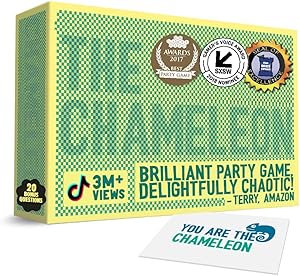
This is the best family board game this Christmas if you want something that works across age groups without feeling like you're playing a kids' game. One player is secretly "The Chameleon"—everyone else knows the secret word, and they have to give one-word clues while trying to figure out who the imposter is. The catch: the Chameleon is trying to blend in while secretly figuring out the word.
What makes this stand out is the elegance of the mechanic. There's no lengthy rulebook, no setup, and no downtime. A round takes maybe 10 minutes, so you can easily play three or four games in a sitting. The included 80 extra secret words mean you're not cycling through the same words repeatedly. I've played this with a group ranging from age 7 to 65, and everyone was equally engaged—not because it was "dumbed down," but because the deduction element works at every level.
The biggest limitation is that it needs at least 3 players to work, and ideally 4+. With just two people, the game loses its deduction element entirely. Also, if your family doesn't enjoy any amount of social deduction or bluffing, this won't appeal to them.
Pros:
- Plays in under 15 minutes per round, so no commitment fatigue
- Works brilliantly with ages 7-70; no "talking down" required
- The hidden role mechanic creates genuine moments of suspicion and laughter
- Affordable entry point at under $20
Cons:
- Needs at least 3 players; not great for two-player households
- If your group dislikes bluffing mechanics, you'll skip this one
- Requires quick thinking—slower players might feel pressured
---
2. Herd Mentality: Udderly Funny Family Board Game | Easy & Fun for Big Groups of 4-20 Players | Includes 20 Extra Exclusive Questions

If you're hosting a larger Christmas gathering—extended family, friends, mixed ages—Herd Mentality: Udderly Funny Family Board Game is built for exactly that scenario. The premise is simple: you're given a category (like "Things that are cold" or "Types of candy") and you have to write down an answer, with the goal of matching what other players wrote, not coming up with the cleverest answer.
The game actually teaches you how your family thinks. You learn that Aunt Linda always says the same things, or that your 10-year-old and your partner think identically about what animals live in the jungle. The questions included lean toward funny and unexpected, not just standard trivia. The 20 extra exclusive questions push you beyond the base set, which matters if you play regularly.
Where Herd Mentality falls short: it plays best with 4-20 players, but the actual experience peaks around 8-12. With fewer people, the "herd" element weakens because you have fewer minds to accidentally align with. It also requires everyone to write simultaneously, so if you have a very young child or someone who struggles with writing, you'll need to modify rules.
Pros:
- Genuinely accommodates large groups without slowing down
- Quick rounds keep momentum high during long gatherings
- Requires zero competitive anger; everyone's just trying to think alike
- The humor is family-appropriate but not juvenile
Cons:
- Not designed for small groups of 2-3 players
- Writing requirement means adjustments needed for pre-readers
- Some families will find the "simple answer" mechanic repetitive after a few plays
---
3. USAOPOLY BLANK SLATE, Where Great Minds Think Alike, Fun Family-Friendly Board Game, Word Association Party Game, Easy to Learn, Fun to Play Family Game Night, 3-8 Players, Ages 8+
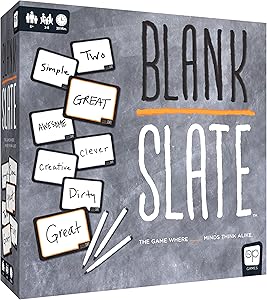
USAOPOLY BLANK SLATE, Where Great Minds Think Alike, Fun Family-Friendly Board Game, Word Association Party Game, Easy to Learn, Fun to Play Family Game Night, 3-8 Players, Ages 8+ is a word-association game where you're trying to match other players' responses without being too obvious or too creative. You get a prompt (like "Things you find in a bathroom") and you write down your answer, then you compare with others.
The beauty of this game is that it rewards being normal, not clever. Your goal isn't to impress everyone with a witty answer; it's to think like your friends. I've found this works especially well with families where there's a real mix of ages because the answers are usually straightforward enough for younger kids but there's still strategy in how you present yourself.
The game board and progression system add a tiny bit of structure that keeps people tracking points and caring about winning, even though the actual fun is entirely in the writing and comparing phase. At $23.39, it's slightly pricier than some alternatives, but the production quality is noticeably solid.
The main downside: if your family is very small (2-3 people), this loses appeal because you have fewer responses to compare. The game also heavily favors people who have good intuition about how others think, so if your household is quite different in personalities and interests, you might get fewer matches overall.
Pros:
- Word-association gameplay is intuitive for ages 8 and up
- Encourages you to think like your family, not against them
- Solid board and components justify the slightly higher price
- Works well with mixed-age groups
Cons:
- Needs at least 3 players to be worth playing
- If your family members are very different, matches will be rare
- Slightly longer setup and explanation than other party games
---
4. Big Potato Sounds Fishy Board Game: The Bluffing Family Game for Kids 10+ - Best New Family Quiz Games, Trivia Games for Groups of People

Big Potato Sounds Fishy Board Game is a trivia game where you don't have to know the answer—you just have to convince others that you do. Someone reads a trivia question and gives multiple-choice answers, and everyone simultaneously votes on which answer they think is correct. Here's the twist: some players are secretly trying to bluff you with fake answers.
This is genuinely brilliant design because it solves the problem of trivia nights where half your family feels outmatched. Even if you don't know the capital of Kazakhstan, you might correctly guess that someone's making something up. The bluffing layer makes it a game of psychology, not just memorization. At $16.99, it's also the most affordable option here, which is a nice bonus.
The game works best with kids 10 and up because the trivia questions assume some basic knowledge, and the bluffing mechanic requires reading social cues. With younger kids, some questions will feel impossible, and the game slows down. It also doesn't scale up well beyond 6-8 players; with a huge crowd, the voting gets chaotic.
Pros:
- Bluffing adds a psychology layer that changes who "wins"
- Trivia questions cover diverse topics, not just obscure facts
- Cheapest option in this list, making it an easy gift choice
- Fast rounds keep energy high
Cons:
- Designed for ages 10+; younger kids will struggle
- Doesn't scale well to very large groups
- Some families find trivia-based games repetitive over time
---
5. I should have known that! - A Trivia Game About Things You Oughta Know, Green

I should have known that! focuses on general knowledge questions—the kind where you feel silly not knowing the answer afterward. It's not asking about obscure historical dates or celebrity trivia; it's asking things like "What is the most spoken language in the world?" or "How many bones are in the human hand?" These are questions where everyone has a vague idea, and the game leverages that.
What I appreciate about this game is that it creates teaching moments. When someone guesses wrong and you reveal the answer, there's often a genuine "oh, that makes sense" reaction. It's especially useful for families with kids because it's educational without feeling like homework.
The game plays smoothly with 2-6 players, and rounds move quickly since it's straightforward question-and-answer format. There's no deep strategy, just general knowledge and educated guesses. This is best for families that genuinely enjoy trivia and learning random facts, not families looking for social deduction or bluffing mechanics.
The limitation is that it's purely trivia-based, so if you've played it a few times and your family has decent memories, the novelty wears off faster than games with deeper mechanics. It also requires at least basic reading ability from all participants.
Pros:
- Questions feel appropriately challenging, not impossibly obscure
- Good for teaching and learning new facts
- Works with 2-6 players comfortably
- Clean, simple ruleset with no fiddly mechanics
Cons:
- Purely trivia-based means less replay value over time
- No bluffing or social deduction element
- Requires reading ability from all players
---
How I Chose These
Finding the best family board game this Christmas meant setting specific criteria: games had to work across age ranges without condescension, play in under 30 minutes, require minimal setup, and create moments where people genuinely laugh or get genuinely competitive without anyone getting upset.
I weighted toward games that don't require special knowledge (so new players aren't immediately disadvantaged) but aren't so simple that adults feel bored. I also prioritized games where the fun comes from how your family interacts, not just from winning or losing. Party games and social deduction games typically deliver this better than traditional competitive games. Price was a factor—all five options fall under $25, making them reasonable gifts—but I didn't let budget override quality or playability.
I specifically looked for games that work with varying player counts because most families don't have exactly 4 people gathering at the table every time. Finally, I looked at actual player feedback and reviews to catch common complaints (like "my kids found this boring" or "this takes forever to explain").
Frequently Asked Questions
What's the best family board game this Christmas for a group with a huge age range?
The Chameleon: Award-Winning Bluffing Board Game works from age 7 to 70 because the deduction mechanic works at any age. If you're planning a large gathering with mixed ages, Herd Mentality: Udderly Funny Family Board Game scales up to 20 players and doesn't require age-specific knowledge.
Which best family board game this Christmas plays fastest?
The Chameleon plays in under 15 minutes per round, making it ideal if your family has limited attention span or you want to fit multiple games into a gathering. Big Potato Sounds Fishy also runs quick rounds.
What if my family is really into trivia?
I should have known that! is your best bet, though Big Potato Sounds Fishy layers in bluffing to keep trivia from feeling too predictable. Both reward general knowledge without punishing players who don't know an answer.
Do any of these work with just two players?
Technically yes, but most of these are designed for 3+ players. The Chameleon needs at least 3 to work properly, and I should have known that! is the most playable at 2 players, though it loses some energy compared to larger groups.
Can these games be played by younger kids?
The Chameleon and USAOPOLY BLANK SLATE work from age 8+. Herd Mentality requires writing ability. Big Potato Sounds Fishy and I should have known that! are designed for 10+.
---
The best family board game this Christmas depends on your specific family, but these five deliver different strengths: The Chameleon for quick, bluffing-based fun; Herd Mentality for large gatherings; USAOPOLY
Get the best board game picks in your inbox
New reviews, top picks, and honest recommendations. No spam, unsubscribe anytime.
More in Family
The Best Board Games for Kids 5-7 in 2026
Finding the right board game for kids aged 5-7 is trickier than it sounds. You need something engaging enough to hold their attention, simple enough that...
Best Board Games for Families with Young Kids in 2026
Finding a board game that actually keeps young kids engaged without making parents want to pull their hair out is harder than it sounds.
The Best Board Games for Families in 2026
Finding great board games for families that actually keep everyone engaged—without someone flipping the board—is tougher than it looks.