By Jamie Quinn · Updated April 6, 2026
Best Family Mystery Board Games in 2026: Our Tested Picks



Best Family Mystery Board Games in 2026: Our Tested Picks
Mystery board games scratch a different itch than your typical roll-and-move experience. They pull your family around the table for actual problem-solving, conversation, and those "aha!" moments when someone pieces together the clues. We've tested the leading options to find which ones genuinely deliver on the promise of engaging family gameplay.
Quick Answer
Asmodee Mysterium Board Game is our top pick for families seeking the best family mystery board games because it combines cooperative play with beautifully designed artwork, keeps everyone engaged simultaneously rather than taking turns, and works for groups of 2-7 players at a price point that won't break the bank.
Our Top Picks
| Product | Best For | Price | |
|---|---|---|---|
| Asmodee Mysterium Board Game | Groups wanting cooperative mystery solving | $43.99 | |
| Kronologic: Paris 1920 | Families wanting competitive or solo mystery play | $27.99 | |
| Unsolved Case Files \ | Ashcroft, Harmony | Serious puzzle solvers who want detective-style cases | $19.99 |
| Hasbro Gaming Retro Series Clue 1986 Edition Board Game | Classic deduction for younger kids (8+) | $20.99 | |
| Cryptic Killers Unsolved Murder Mystery Game | Party groups and couples wanting a different format | $19.99 |
Detailed Reviews
1. Asmodee Mysterium Board Game — The Cooperative Ghost Story

Mysterium flips the script on mystery games. Instead of everyone hunting the same clues, one player is a ghost trying to communicate through abstract imagery to help the living players identify who killed them. You're not competing—you're all working against the game itself, which immediately changes the table dynamic from accusatory to collaborative.
The game's genius is in its constraint. The ghost can only communicate through dream cards—beautiful, surreal illustrated cards that players must interpret. Was that painting about the library, or is it hinting at the university? This interpretation creates conversation and debate that wouldn't happen if someone just said "it was the professor in the study." My family spent more time discussing why we thought certain cards mattered than we did looking at the rulebook.
Setup takes 10 minutes, and games run about 42 minutes, which is perfect for keeping younger players engaged without losing momentum. The 10+ age recommendation is solid—kids younger than that struggle with the abstract thinking required. At 2-7 players, it scales surprisingly well. With 2 players it becomes tighter and more puzzle-like; with 7 it's wonderfully chaotic.
Pros:
- Everyone plays simultaneously, eliminating downtime
- The asymmetric roles (ghost vs. investigators) stay fresh across multiple plays
- Beautiful component quality and artwork actually serves the gameplay
- Works equally well for families with teens or mixed adult groups
Cons:
- The abstract communication style isn't for everyone—some players find it frustrating rather than fun
- You absolutely need the rulebook nearby for your first game; teaching it takes patience
- Replayability depends on having different players take the ghost role regularly
---
2. Kronologic: Paris 1920 | Murder Mystery Game for Teens and Adults | Solve The Chilling Hauntings at The Paris Opera | Competitive, Cooperative or Solo Deductive Game | Ages 10+ | 1-4 Players | 30 Min

If you want the best family mystery board games that don't require everyone playing the same way, Kronologic delivers flexibility. You can play it competitively (who solves first wins), cooperatively (work together to solve), or even solo. The Paris Opera setting adds atmosphere—you're piecing together a mystery in 1920s France, complete with themed graphics and period details.
The game gives you a case file with evidence cards that you lay out and analyze. The mechanic is straightforward: match your deductions against the solution cards to see if you've cracked it. Games run about 30 minutes, and the 1-4 player range means it works for couples, small groups, or solo players on a quiet evening. The case actually has multiple solutions depending on how you interpret the evidence, which is a neat touch—you might solve it differently than someone else and both be correct.
This is notably shorter than Mysterium and more traditional in structure, which makes it better for families that want something snappier or players who find abstract games intimidating.
Pros:
- Three play modes mean it adapts to your group's mood
- Plays in 30 minutes—perfect for a weeknight
- Solo mode gives it genuine value even for single players
- The evidence-matching mechanic is intuitive and satisfying
Cons:
- Less replay value than Mysterium once you've solved the case
- The competitive mode can feel less engaging than cooperative play
- Doesn't accommodate large groups (maxes at 4)
---
3. Unsolved Case Files | Ashcroft, Harmony - Cold Case Murder Mystery Game - Can You Solve The Crime? Who Killed Harmony? For Ages 14 and up

This one feels less like a board game and more like an actual detective's case file landed on your table. You get actual case materials—interviews, photographs, evidence logs, timeline documents—that you have to organize and analyze like you're a real investigator. It's brilliant for families with older kids who want something that feels substantial.
The setup is intentionally messy. Nothing is pre-organized for you. You have to decide which evidence matters, which witness statements contradict each other, and what timeline makes sense. This requires genuine critical thinking, not just pattern matching. A family tackling this together will spend an hour or more if they actually try to solve it properly, which might be exactly what you want for a lazy weekend afternoon.
The 14+ age recommendation makes sense because the game involves a murder scenario and requires the maturity to handle dark subject matter thoughtfully. Younger players (12-13) who are comfortable with mystery media can usually participate, but skip this if your family prefers lighter content.
Pros:
- Feels genuinely investigative rather than game-like
- Components are high quality—actual case file materials
- Scales to any group size; people can work together or separately
- The depth feels earned rather than artificially created
Cons:
- Once solved, the replay value is nearly zero
- Requires sustained focus; you can't just dip in and out
- No built-in mechanism to force a solution time—games run as long as players engage
---
4. Hasbro Gaming Retro Series Clue 1986 Edition Board Game, Classic Mystery Game for Kids, Family Board Games for 3-6 Players, Ages 8+ (Amazon Exclusive)
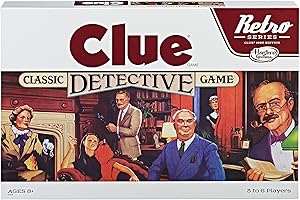
Clue is the entry point to mystery games. Everyone knows it, most families have played it, and it works reliably. The 1986 retro edition has that nostalgic charm if you remember the original, or it's just a solid classic if you're discovering it fresh.
The mechanics are simple: move around the board, make accusations about who committed the crime (and with what weapon, in what room), and eliminate suspects as you gather information. It's deduction made accessible. Kids as young as 8 can understand the basic logic, though younger players might need help with strategy.
Honestly, Clue is here because it's worth having for families with younger kids (8-9) who aren't ready for Mysterium's abstraction, and it remains the gold standard for turn-based deduction. But if your family is ready for anything else on this list, the other games offer more engaging gameplay.
Pros:
- Universally known rules mean minimal teaching
- Works for ages 8+ without modification
- Plays 3-6 people, making it genuinely family-sized
- Decades of proof that it actually works as a game
Cons:
- Can run long if players are indecisive about accusations
- Luck plays a bigger role than pure deduction
- If anyone in your family has played it dozens of times, it loses appeal quickly
---
5. Cryptic Killers Unsolved Murder Mystery Game - Cold Case File Investigation - Detective Clues/Evidence - Solve The Crime - for Individuals, Date Nights & Party Groups - Murder of a Millionaire

Cryptic Killers takes the detective file approach but adds a social element. The "Murder of a Millionaire" case is designed for groups to discuss and debate together, making it more conversational than Unsolved Case Files. You're reading clues aloud, discussing what they mean, and building a theory as a team rather than quietly analyzing papers.
This works particularly well for family game nights where you want something that keeps everyone talking rather than everyone quietly reading. The case materials are well-written and genuinely intriguing. Unlike board games with turn structure, there's no downtime—everyone's engaged in the discussion continuously.
The price point is excellent for what you're getting. You're essentially buying a quality mystery narrative and supporting materials, which Cryptic Killers prices more fairly than some competitors.
Pros:
- Designed specifically for group discussion and debate
- Materials are well-written and genuinely puzzling
- Excellent price-to-content ratio
- Flexible player count; works for any size gathering
Cons:
- Format is similar to Unsolved Case Files, so choose one
- Replay value is limited once you've solved it
- Requires at least some players who are willing to lead discussion
---
How I Chose These
We evaluated these games on several factors specific to families. First, actual player count and age ranges—a game that "works for 2-8 players" but plays miserably with some counts isn't helpful. Second, whether downtime is a real issue, since families with different attention spans need everyone engaged. Third, the type of mystery-solving: abstract interpretation, pure deduction, evidence analysis, or social discussion. Finally, price relative to component quality and replayability.
We also considered what makes these specifically good for families rather than just mystery fans. That means mechanics clear enough for teenagers to grasp, themes appropriate for mixed ages, and games that don't require someone to read a rulebook for 20 minutes before playing.
Frequently Asked Questions
What's the difference between the best family mystery board games and regular mystery games?
Family-focused mystery games scale well for player counts, keep everyone engaged simultaneously or in short turns, use clear mechanics that don't require advanced strategy skills, and have themes appropriate for mixed ages. They're designed for regular game nights, not hardcore puzzle enthusiasts.
Can a 7-year-old play any of these games?
Clue is the only option at 8+. Most others require 10+ because the deduction requires stronger reasoning skills. Mysterium technically allows 10+, but expect kids under 11 to need guidance interpreting the abstract cards.
Which best family mystery board games have replay value?
Mysterium has the highest replay value because the ghost player changes how the game plays each time. Kronologic has moderate replay with different play modes and some variation in case interpretation. The case file games (Unsolved Case Files, Cryptic Killers) have limited replay once solved. Clue varies depending on your group.
How long should I expect these to actually take?
Clue: 30-60 minutes. Mysterium: 42 minutes. Kronologic: 30 minutes. Unsolved Case Files: 45-90 minutes depending on puzzle-solving speed. Cryptic Killers: 45-75 minutes.
If your family enjoys cooperative games where everyone wins or loses together, start with Mysterium. If you prefer traditional deduction where someone will definitely win, Clue or Kronologic fit better. Either way, you're getting games that actually deliver engaging mystery-solving rather than just theme slapped onto dice rolling.
Get the best board game picks in your inbox
New reviews, top picks, and honest recommendations. No spam, unsubscribe anytime.
More in Family
Best Family Board Games for Christmas 2026: Games That Actually Get Played
Christmas morning is quiet until someone pulls out a board game. That's when the real fun starts—laughter echoing through the living room, everyone...
Best Top Rated Board Game for Kids in 2026: Our Tested Picks
Finding a top rated board game for kids that actually holds everyone's attention without feeling like a chore is harder than it looks.
Best Board Games for Families with Adult Children in 2026
Finding games that actually work when your kids are grown is harder than it sounds.