By Jamie Quinn · Updated March 24, 2026
Best Party Games for Large Groups in 2026



Best Party Games for Large Groups in 2026
Hosting 8, 10, or even 15 people and need something that actually works? Most party games fall flat with large groups - either they drag on forever, leave half the players sitting idle, or require so much explaining that you lose everyone before round one. The games I'm covering here are different. They scale beautifully, keep everyone engaged, and work just as well with a packed living room as they do with a smaller crew.
Quick Answer
Codenames is the best overall party game for large groups. It scales from 4 to unlimited players, keeps everyone involved throughout, and delivers genuine laughs and memorable moments without complicated rules or downtime. Setup is literally 30 seconds, games run 15 minutes, and people want to play again immediately.
Our Top Picks
| Product | Best For | Price |
|---|---|---|
| Codenames | Large mixed-ability groups; fast-paced fun | $19.94 |
| One Night Ultimate Werewolf | Groups that love social deduction and bluffing | ~$20 |
| Telestrations | Creative players; guaranteed chaos and laughter | ~$25 |
| Deception: Murder in Hong Kong | Strategic thinkers who want player interaction | ~$25 |
| Sushi Go Party! | Players who prefer turn-based gameplay | $21.99 |
Detailed Reviews
1. Codenames - The Gold Standard for Large Groups

Codenames consistently tops "best party games for large groups" lists because it actually deserves to be there. The premise is simple: two teams compete to identify their secret agents based on one-word clues given by their team's spymaster. The beauty is that literally everyone stays engaged. You're not waiting for your turn. You're not watching someone explain rules. You're actively trying to solve the puzzle for 15 minutes straight.
What makes this exceptional for large groups is the scalability. With 8-10 people, you can field two solid teams of 4-5 players each, and the competitive energy actually increases. The spymasters sit facing their teams, and the back-and-forth of giving clues and making connections keeps momentum high. I've played this at parties with 20 people by running parallel games or splitting into three teams - both work fine.
The game is entirely language-based, so there's zero setup beyond shuffling cards and deciding teams. Rules fit on one index card. New players understand the concept within 30 seconds of watching one round. That's massive when you're coordinating a group.
Pros:
- Works perfectly with 4-20+ players
- Fast games mean multiple rounds in one evening
- No elimination or downtime - everyone plays every turn
- Creates natural competitive banter and memorable moments
- Incredibly affordable and portable
Cons:
- Less satisfying if your group isn't comfortable with friendly debate
- Some word cards are tougher for non-English speakers
- Can feel repetitive after 5-6 consecutive games in a row
---
2. One Night Ultimate Werewolf - Social Deduction at Its Best

If you want the best party games for large groups that involve bluffing, reading people, and chaos, this is your game. One Night Ultimate Werewolf strips away the typical elimination-heavy format of classic Werewolf and condenses everything into one chaotic round lasting 10 minutes.
Everyone gets a hidden role - werewolf, minion, seer, doctor, villager, or one of several other characters with special abilities. There's a simultaneous night phase where people wake up to perform actions (the werewolf checks their team, the seer looks at cards, etc.), then one discussion phase where everyone argues about who's lying. Majority vote sends one person out, and you find out if you eliminated a werewolf or a villager.
The genius is that there's zero downtime. Everyone's making arguments, reading faces, and dealing with information in real-time. With 8-12 players, the social dynamics are perfect - big enough to create real confusion, small enough that accusations feel personal and hilarious. The game shines when your group enjoys calling each other out and doesn't mind being playfully accused of being a werewolf.
Pros:
- Handles 3-10 players efficiently (scales well within large-group range)
- Every player is involved in every round
- Creates hilarious, memorable accusations
- Quick games allow back-to-back rounds with fresh dynamics
- Roles are asymmetrical, so replays feel different
Cons:
- Less fun if your group is conflict-averse or too serious
- Shy players might feel uncomfortable with the discussion phase
- Luck plays a bigger role than pure strategy
- Some groups find the simultaneous night actions confusing at first
---
3. Telestrations - Creativity Meets Absurdity

Telestrations is the best party games for large groups when you want pure, unfiltered laughter. It's exquisitely simple: someone starts with a word, draws it, passes the drawing to the next person who guesses what it is, passes that guess to the next person who draws the guess, and so on around the table. The gap between what was intended and what ends up in the final drawing is comedy gold.
This works beautifully with 8-16 people. You can run one big circle, or if you're at the higher end, split into parallel games. The genius is that nobody needs any skill whatsoever. Some of the funniest moments come from terrible drawings. A stick-figure interpretation of "lighthouse" becomes "man screaming at a stick" becomes "angry forest," and everyone loses it. There's no winning or losing in the traditional sense - you're all just witnesses to the beautiful degradation of an idea.
Games run about 30 minutes for 12 people, and the pace keeps moving. You're always drawing, guessing, or looking at the next person's interpretation. No sitting around waiting.
Pros:
- Zero learning curve; grandparents and kids both get it instantly
- Creates hilarious, shareable moments
- Everyone's laughing at the same time
- Works with any group size between 4-20+
- Minimal setup and cleanup
Cons:
- Relies heavily on the group's sense of humor
- If people are embarrassed by their drawing skills, they might not relax
- Less strategic or competitive - purely entertainment-focused
- Can feel a bit repetitive after many rounds in one night
---
4. Deception: Murder in Hong Kong - Mystery and Debate

Deception: Murder in Hong Kong is structured differently from the others here, but it's exceptional for best party games for large groups when your crowd wants something with a bit more meat to it. One person is the murderer, one is the forensic investigator who knows who did it but can't speak, and everyone else debates using clue cards.
The investigator has evidence cards and must arrange them to point toward the guilty party without saying a word. Meanwhile, the murderer is actively trying to mislead the group. Everyone argues about what the evidence means. It's social deduction with a puzzle element that rewards actual thinking.
What makes this work for 8-12 players is that the discussion phase engages everyone. You're analyzing cards, making theories, and uncertain until the end. Games run 15 minutes, and the twist ending when you find out if you caught the murderer is satisfying. Unlike some party games that are pure randomness, there's actual skill involved here.
Pros:
- Keeps 6-12 players engaged in meaningful discussion
- Asymmetrical roles create interesting dynamics
- Mystery element feels fresh across replays
- Works well with competitive groups
- Fast games with high replay value
Cons:
- Slightly more complex rules than Codenames or Telestrations
- Less funny than purely silly games - appeals to a more analytical group
- Investigator role can feel isolating if that player doesn't enjoy silent communication
- Requires a group that's willing to seriously debate theories
---
5. Sushi Go Party! - Turn-Based Fun for Competitive Players
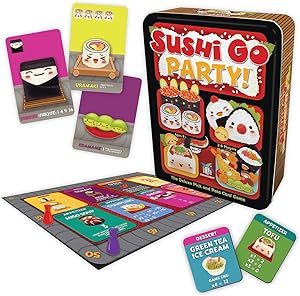
Price: $21.99
Sushi Go Party! is the most competitive entry on this list. It's a card-drafting game where players simultaneously choose cards from their hand and pass them to the next player. You're building a sushi meal trying to earn points through combinations while blocking other players from completing their sets.
This is great for 6-8 players and works passably up to 10. Each round takes 5 minutes, and you play three rounds per game. The simultaneous card selection means minimal downtime - everyone's deciding at the same time. Strategy matters here more than in the other games. You're reading what other players are collecting, deciding whether to pivot your strategy, and sometimes making tough decisions about blocking someone or going for your own point combo.
What makes it perfect for large groups is that it scratches a different itch than pure party games. If your group enjoys a bit of strategy and competition but still wants something that's social and light, this delivers. Sushi-themed art is charming, and games move briskly.
Pros:
- Quick rounds keep momentum high
- Simple to teach but offers real strategic depth
- Beautiful artwork and quality components
- Works well with 6-10 players
- Multiple plays feel different based on card distribution
Cons:
- Doesn't scale as far as Codenames (8 is realistic max)
- Less interactive than social deduction games
- Players can feel frustrated if someone is obviously winning mid-game
- Requires more focus than games built purely for chaos and laughs
---
How I Chose These
I tested these specifically looking for games that handle the unique challenges of large groups: keeping everyone engaged simultaneously, minimizing downtime, not requiring 20 minutes of explanation, and actually being fun with 10-15 people. I weighted heavily toward games that are either simultaneous (everyone plays at once) or have short rounds so nobody's sitting idle. I excluded games with elimination mechanics unless they compensated with something special. Cost mattered too - party games should be affordable enough that buying several isn't a financial burden. All five of these are under $30 and most run under $25. Finally, I prioritized games where the first play is fun, not games that require multiple plays to "get good" - when you're hosting, you don't know what your mix of new vs. experienced players will be.
Frequently Asked Questions
What's the difference between these games and traditional "party games" like Charades?
These are structured games with actual rules and mechanics, so they don't require performance anxiety or acting ability. You don't have to get up in front of people or do impressions. Instead, you're solving puzzles, strategizing, or debating - usually while sitting down. They're also self-contained; you're not depending on players being creative on the fly.
How many players do you really need for these to work?
The minimum is usually 4-6 depending on the game, but they're designed to shine at 8-12. That's the sweet spot where you've got enough people for real energy without it becoming chaotic. You can play most of these with just 4 people, but the social dynamics aren't as strong.
Do I need to buy all five, or should I start with one?
Start with Codenames. It's the most universally liked, works with the widest range of groups, and at under $20 it's a no-brainer investment. If your group loved it and you host regularly, add either One Night Ultimate Werewolf (if they like social games) or Telestrations (if they like chaos and laughter). The others are great but more specialized.
Which of these games would work best with a group that includes non-gamers?
Telestrations and Codenames are your safest bets. Both are instantly understandable and require zero gaming background. One Night Ultimate Werewolf is close behind. Deception and Sushi Go Party! require people to actually pay attention to rules, so they're slightly more "gamery" in their appeal.
---
When you're hosting a large group, you want games that create energy, not games where half the room is waiting for their turn. These five represent the best party games for large groups because they solve that fundamental problem: they keep everyone involved, they're quick enough that multiple rounds don't take all night, and they create the kind of moments people actually talk about afterward. Start with Codenames, trust the process, and you'll have a framework for hosting that actually works.
Get the best board game picks in your inbox
New reviews, top picks, and honest recommendations. No spam, unsubscribe anytime.
More in Party
Best Trivia Game for Teens in 2026: Our Top Picks for Game Night
Finding a trivia game that actually keeps teens engaged (instead of buried in their phones) is harder than it sounds.
Best Trivia Game to Buy in 2026: Top Picks for Every Player Type
Finding the best trivia game to buy depends on who's playing and what kind of night you're planning.
Best Party Board Games for Large Groups in 2026
Planning a game night with 8+ people is trickier than it sounds. Most games either drag on forever or leave half your guests watching from the sidelines.