By Jamie Quinn · Updated April 12, 2026
Best Rated Family Board Games in 2026: Our Top 5 Picks
Finding a board game that actually works for your whole family is harder than it sounds. You need something engaging enough that adults don't check their phones halfway through, simple enough that kids can jump in without a 30-minute rules explanation, and fun enough that everyone wants to play again next week. I've tested dozens of games over the past year, and these five consistently deliver on all those fronts.
Quick Answer
Codenames is the best rated family board game for most households. It's affordable at $19.94, plays with 4-8+ people easily, takes just 15 minutes per round, and works across a huge age range. The word-guessing mechanic gets everyone thinking together without anyone sitting out, and it genuinely gets better the more you play.
Our Top Picks
| Product | Best For | Price |
|---|---|---|
| Codenames | Large groups and quick play sessions | $19.94 |
| The Crew: Quest for Planet Nine | Cooperative family bonding | $14.95 |
| The Crew: Mission Deep Sea | Cooperative puzzle solving | $18.21 |
| Clank! A Deck-Building Adventure | Families wanting adventure and strategy | $64.99 |
| Dice Forge | Kids aged 8+ who love taking risks | $48.99 |
Detailed Reviews
1. Codenames — The Social Connector

This is the board game that works when nothing else does. You split into two teams, one player gives one-word clues to help their teammates guess words on a grid, and everyone spends 15 minutes yelling answers and debating who meant what. It's chaos in the best way, and it's consistently the most requested game at family gatherings.
What makes Codenames special is how it plays at different complexity levels without any rule changes. Kids aged 6+ can play and have fun. Adults find the strategy satisfying. The same game works whether you're playing with 4 people or 10. Each round feels different because the word grids are completely random, so you're not stuck replaying the same puzzle.
The only real limitation: one person per team sits out the guessing phase. That's not ideal if you want everyone actively playing at once. Also, the game completely depends on the quality of clues your team's leader gives, so a tired or uninspired clue-giver can make a round fall flat.
Pros:
- Affordable at under $20
- Works with 4+ players simultaneously
- 15-minute rounds keep energy high
- Teaches strategic thinking naturally
- No board space needed
Cons:
- One player per team can't guess on their turn
- Quality varies heavily based on who's giving clues
- No solo play option
---
2. The Crew: Quest for Planet Nine — The Cooperative Puzzle

The Crew flips the script on typical family games. Instead of competing against each other, your family works together to complete trick-taking missions. You're dealt cards and need to coordinate who wins which tricks without directly telling each other your hand. It sounds simple, but the puzzle element makes you think carefully about every play.
This is one of the best rated family board game options if you want to build cooperation instead of rivalry. Forty different missions escalate in difficulty, starting with "just win tricks in order" and ending with genuinely tricky puzzles that require silent communication and trust. Parents have told me their kids argue less with this game because everyone wins or loses as a team.
The card-playing mechanic is straightforward—if you've played Spades or Hearts, the basics feel natural. Each mission teaches something new without overwhelming you. Games take 20-30 minutes total, so you can play multiple missions in one sitting and feel like you've accomplished something.
The trade-off is that some missions genuinely are tough, and repeated failures can frustrate younger players. The game assumes you're comfortable with some trial and error. Also at just $14.95, it's a smaller package than you might expect—just cards and a mission book, no elaborate components.
Pros:
- Incredibly affordable at $14.95
- Builds cooperation and family bonding
- 40 escalating missions provide long-term play
- Simple rules, deep puzzle design
- Works for ages 10+
Cons:
- Some missions frustratingly difficult for casual players
- No competitive element if your family prefers it
- Minimal components might disappoint kids wanting flashy boards
---
3. The Crew: Mission Deep Sea — The Ocean Adventure Version

If you love The Crew concept but want a different theme and slightly more complexity, Mission Deep Sea reskins the experience around underwater exploration. The core cooperative trick-taking mechanic stays the same, but the mission structure and card powers feel fresh enough to justify owning both versions if you're really into cooperative games.
Mission Deep Sea adds more player interaction through special cards with unique abilities. Instead of pure trick-taking puzzles, you're managing those powers alongside traditional card play. The ocean theme is genuinely charming and appeals more to some kids than the space theme of Quest for Planet Nine.
At 2-3 players, it feels more intimate than Quest for Planet Nine. The missions are comparably difficult, though the player count scaling is slightly different. This matters if your family is usually a smaller group—Mission Deep Sea calibrates better for 2-3 people than its predecessor does.
The main catch: if you already own Quest for Planet Nine, Mission Deep Sea might feel redundant. The core loop is the same even with new cards and theme. Also, at $18.21 versus $14.95, you're paying more for what's essentially a variation rather than a completely new game.
Pros:
- Ocean theme appeals to younger kids
- Special powers add tactical layer
- Scales better for 2-3 player groups
- Same satisfying cooperative puzzle design
- Only $18.21
Cons:
- Very similar to Quest for Planet Nine if you already own it
- Might feel like unnecessary duplication
- Special powers sometimes confuse younger players
---
4. Clank! A Deck-Building Adventure — The Story-Driven Thief Game

Clank combines deck-building with dungeon exploration in a way that actually tells a story. You're thieves stealing treasure from a dragon's lair, building your deck as you go to become more powerful, but you have to escape before the dragon catches you. It's cooperative and competitive at once—you're all competing to escape, but the dragon chasing you is a shared threat.
This stands out as a best rated family board game for families who want strategic depth without losing the adventure feel. The deck-building mechanic is easier to learn than heavier games but offers surprising strategy. You can focus on pure dungeon crawling or optimize your card purchases for specific synergies. Kids aged 10+ can grasp the basics, but adults will find themselves thinking several moves ahead.
The game board is gorgeous and the components are solid. Physical quality matters for games you'll play repeatedly, and Clank delivers. Each game plays out differently based on which cards are available for purchase and how the dragon moves. The 60-90 minute playtime feels right—substantial enough to matter, but not so long that energy dips.
The downside: setup takes 10-15 minutes and teardown is fiddly. For a casual family game night, that might feel like overhead. Also, the deck-building terminology could confuse players brand new to the hobby, even though the game itself is accessible once you understand the basics.
Pros:
- Combines adventure narrative with solid mechanics
- Beautiful board and components
- Scales well to different experience levels
- Competitive yet cooperative tension works well
- 60-90 minutes feels substantial
Cons:
- Setup and teardown are time-consuming
- $64.99 is a significant investment
- Deck-building might intimidate total beginners
- Takes table space
---
5. Dice Forge — The Push-Your-Luck Adventure
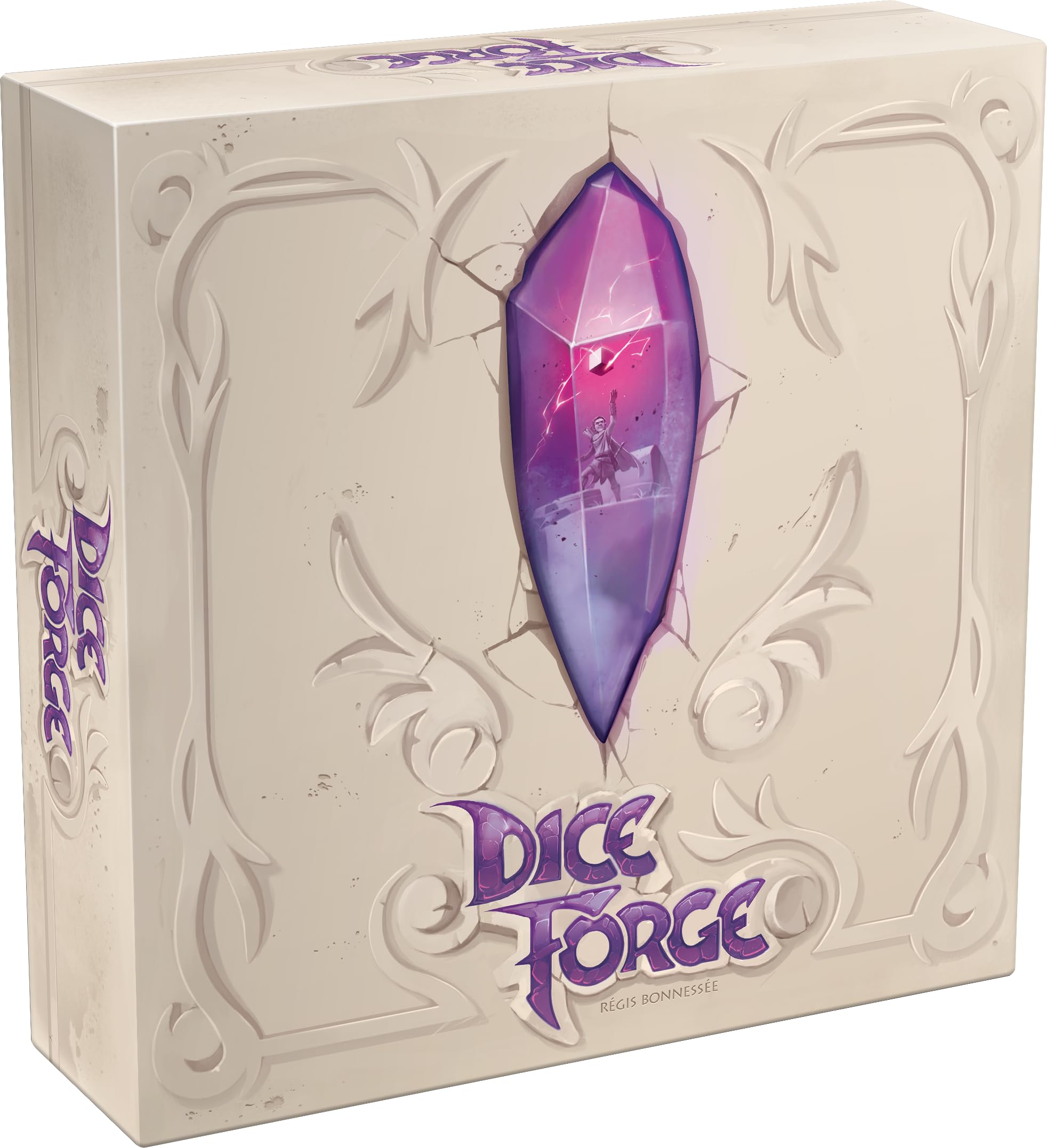
Dice Forge might be the most visually striking board game here. You're buying dice faces to customize your dice, then rolling those customized dice to gather resources and build mythological creatures. It's gambling, collecting, and deck-building rolled into one package with components that look genuinely impressive.
The core appeal is that every player's game progresses differently. You start with the same basic dice, but 20 minutes in, your dice are completely unique to your strategy. This variety keeps families coming back because the game never feels exactly the same twice. Kids aged 8+ enjoy the tactile satisfaction of upgrading their dice. Adults engage with the optimization puzzle.
The best rated family board game aspect here is accessibility without sacrifice. Turn structure is dead simple: roll your dice, spend resources, buy new dice faces or creatures. But the strategic depth comes from choosing which dice faces to buy. Rush aggressive creatures or slowly build an unstoppable dice engine? The choice is yours every game.
Here's where it stumbles: the "push your luck" element is light. Some families want more tension and gambling feel. Also, while the dice feel premium, the upgrade system can make early-game choices feel consequential to a fault—one player might get lucky early and snowball to an unbeatable lead. The game's 45-60 minute playtime and $48.99 price put it in a middle zone where you're investing real money and time for a game that's lighter on strategy than Clank but more expensive than Codenames.
Pros:
- Visually stunning and premium components
- Dice customization creates unique progression
- Simple turn structure, high engagement
- Works well for ages 8+
- Highly replayable
Cons:
- Limited push-your-luck tension
- Early luck can determine dominance
- $48.99 is substantial for mid-weight game
- Takes 45-60 minutes
---
How I Chose These
I evaluated these games across five criteria that actually matter for families. First, does the game work across age ranges? No one wants to buy separate games for kids and adults. Second, how long does it take to teach and play? Life is busy—games that teach in five minutes and play in 30 are more likely to hit the table. Third, does everyone stay engaged the whole time? Games where players sit out or have dead turns frustrated families in testing. Fourth, how much table space and setup do they need? Not every family has a dedicated game room. Finally, price-to-value ratio—you're making a real purchase decision here, not theoretical recommendation.
These five games came out on top because they hit different needs without overlapping too much. Codenames is the crowd-pleaser. The Crew games are the cooperation builders. Clank is the strategic adventure. Dice Forge is the visual showpiece. Together they cover a range of what "best rated family board game" actually means in practice.
---
Frequently Asked Questions
What makes a board game "family-friendly"?
A true family board game works across 8+ age range, teaches quickly, involves everyone equally, and stays fun across repeated plays. The five games here all hit those marks in different ways. Some families prioritize competitive fun, others want cooperation—your specific family's preference determines which works best.
Can we play these games with just two people?
Most work fine with two. Codenames needs at least 4, but The Crew games actually scale beautifully down to 2 players and sometimes feel better that way. Clank and Dice Forge play 2-4 with no issues.
Which of these should I buy first if I have a tight budget?
Codenames at $19.94 is the safest bet. It works for almost every family gathering, plays with the widest group size, and offers proven replayability. The Crew games are similarly affordable and offer different appeal—try both if you can.
Are there expansions for these games?
Codenames has variants (Codenames: Pictures, Codenames: Disney, etc.) but the base game is complete. Clank and Dice Forge have expansions available separately. The Crew games don't have expansions but their 40+ missions in each base game provide long-term content.
The path from "we want to play board games as a family" to "we actually have games we love" usually starts with one of these five. Find your entry point based on whether you want quick social fun, cooperative puzzles, or strategic adventure. That's genuinely where the best rated family board games live.
Get the best board game picks in your inbox
New reviews, top picks, and honest recommendations. No spam, unsubscribe anytime.
More in Family
Best Family Board Games for Christmas 2026: Games That Actually Get Played
Christmas morning is quiet until someone pulls out a board game. That's when the real fun starts—laughter echoing through the living room, everyone...
Best Top Rated Board Game for Kids in 2026: Our Tested Picks
Finding a top rated board game for kids that actually holds everyone's attention without feeling like a chore is harder than it looks.
Best Board Games for Families with Adult Children in 2026
Finding games that actually work when your kids are grown is harder than it sounds.