By Jamie Quinn · Updated April 11, 2026
Best Solo Board Games With Small Footprint in 2026



Best Solo Board Games With Small Footprint in 2026
Playing board games solo used to mean pulling out a rulebook designed for multiplayer and ignoring half the mechanics. Now there are genuinely excellent games built for solo play that won't require you to clear your entire dining table. If you live in an apartment, travel frequently, or just prefer gaming at a desk or small coffee table, finding the right solo board game with a small footprint changes everything.
Quick Answer
Marvel Champions: The Card Game is the best starting point for most people hunting solo board games with a small footprint. It costs $55.99, plays in under an hour, takes up roughly the space of a shoebox, and the solo experience is genuinely engaging rather than bolted-on. If you want something more complex, The Crew: Quest for Planet Nine offers incredible depth at just $14.95.
Our Top Picks
| Product | Best For | Price |
|---|---|---|
| Marvel Champions: The Card Game | Quick solo sessions, card game lovers, minimal setup | $55.99 |
| The Crew: Quest for Planet Nine | Budget-conscious players, puzzle-like gameplay | $14.95 |
| Mage Knight Board Game | Deep strategic challenge, fantasy theme lovers | $149.95 |
| Robinson Crusoe: Adventures on the Cursed Island | Survival themes, narrative storytelling | $54.55 |
| Spirit Island | Heavy strategy, asymmetric mechanics | $58.12 |
Detailed Reviews
1. Marvel Champions: The Card Game — Perfect for Desk Gaming
Marvel Champions stands out because it feels like a full game even when you're the only player. You build a deck around a Marvel hero, then fight increasingly difficult villains. The base box includes Spider-Man, Captain Marvel, Iron Man, and Black Panther, each with completely different playstyles. Solo, you're essentially racing against the villain's threat counter while managing your hero's health and building resources.
What makes this work for small spaces is the card-driven nature. Everything lives in your hand or on a small play area in front of you. You're not shuffling around tokens or managing a sprawling board. Each game runs 30-50 minutes depending on difficulty, and setup takes maybe five minutes. The difficulty scaling means you can start easy and work toward genuinely challenging encounters without the game feeling impossible.
The solo experience doesn't feel like an afterthought—it's legitimately how the designer intended people to play. You're not controlling multiple hands or playing as fake opponents. It's just you versus the game's AI, which works perfectly for solo board games with small footprint requirements.
Pros:
- Takes up minimal table space, plays great at a desk
- Excellent difficulty scaling from beginner to brutal
- Quick setup and cleanup
- Tons of expansion content available if you want variety
Cons:
- Card sleeving (protecting cards with plastic sleeves) is almost essential and costs extra
- Limited hero selection in the base box (four heroes)
- Can feel a bit repetitive if you only play one hero constantly
2. The Crew: Quest for Planet Nine — Brilliant Puzzle Game for the Price
The Crew costs $14.95, which honestly seems impossible for how good it is. It's a cooperative card game where you're trying to complete trick-taking objectives across 50 escalating missions. But here's the thing—you can't talk to other players beyond a handful of allowed communication methods. Solo, you're managing multiple hands simultaneously, which sounds tedious but actually becomes a fascinating logic puzzle.
Each mission gives you specific objectives. Mission 1 might be "Player 1 must win the rocket card." Mission 15 might be "no player can win the 1 card." You're arranging your hand distribution across imaginary players and then executing those hands one by one, trying to make everything work. It's like solving a card-game sudoku.
The footprint is genuinely tiny. You need space for maybe six cards at a time. The entire box fits in a backpack pocket. Missions take 10-20 minutes each, and the campaign progresses such that you can stop after any mission and resume later without losing context.
This is genuinely one of the best solo board games with small footprint if you like puzzle-solving over narrative or theme. The missions escalate in difficulty organically, and failures feel fair because you can see exactly where your logic broke down.
Pros:
- Ridiculously cheap for the quality
- Occupies almost no space on your table
- 50 missions mean genuine long-term replayability
- Perfect for travel or commuting
Cons:
- Requires mental gymnastics to manage multiple hands
- Not thematic or narrative-driven at all
- Some players find the puzzle nature less engaging than typical board games
3. Mage Knight Board Game — Deep Strategy for Serious Players

Mage Knight at $149.95 is expensive, but it's also the gold standard for complex solo games that don't demand a huge table. You're playing as a mage exploring a hexagonal grid, conquering towns, defeating monsters, and collecting spells. The core loop involves playing cards from your hand to move, cast spells, and attack. It sounds straightforward until you realize you're balancing several mechanical systems simultaneously.
The game uses a modular board that changes every session, so replayability is built in. Difficulty scaling lets you add or remove challenges, and the solo campaign can span multiple sessions. You could spend 2-3 hours on a single scenario, or knock out a shorter version in 45 minutes.
Why this works for small footprints is that the actual "board" is only as big as you need it to be. The hexes expand from your starting position, so it's never sprawling across an entire table. Most of your actual management happens in your hand and in front of you. However, you do need decent organization for cards, tokens, and spell tracking. This isn't a game you'll comfortably play standing up or in a tight space.
This is best for players who want serious strategic depth and don't mind rules complexity. The learning curve is steep, and the rulebook requires study. But once it clicks, the puzzle of optimizing your mage's potential is genuinely addictive.
Pros:
- Excellent solo experience with asymmetric difficulty scaling
- Modular board means different layout each game
- Genuinely challenging strategic puzzles
- Long campaign potential if you want it
Cons:
- Steep learning curve with a dense rulebook
- Requires more table space than other games on this list
- Can suffer from "quarterbacking" fatigue if you're indecisive
- Price is substantial
4. Robinson Crusoe: Adventures on the Cursed Island — Survival Narrative
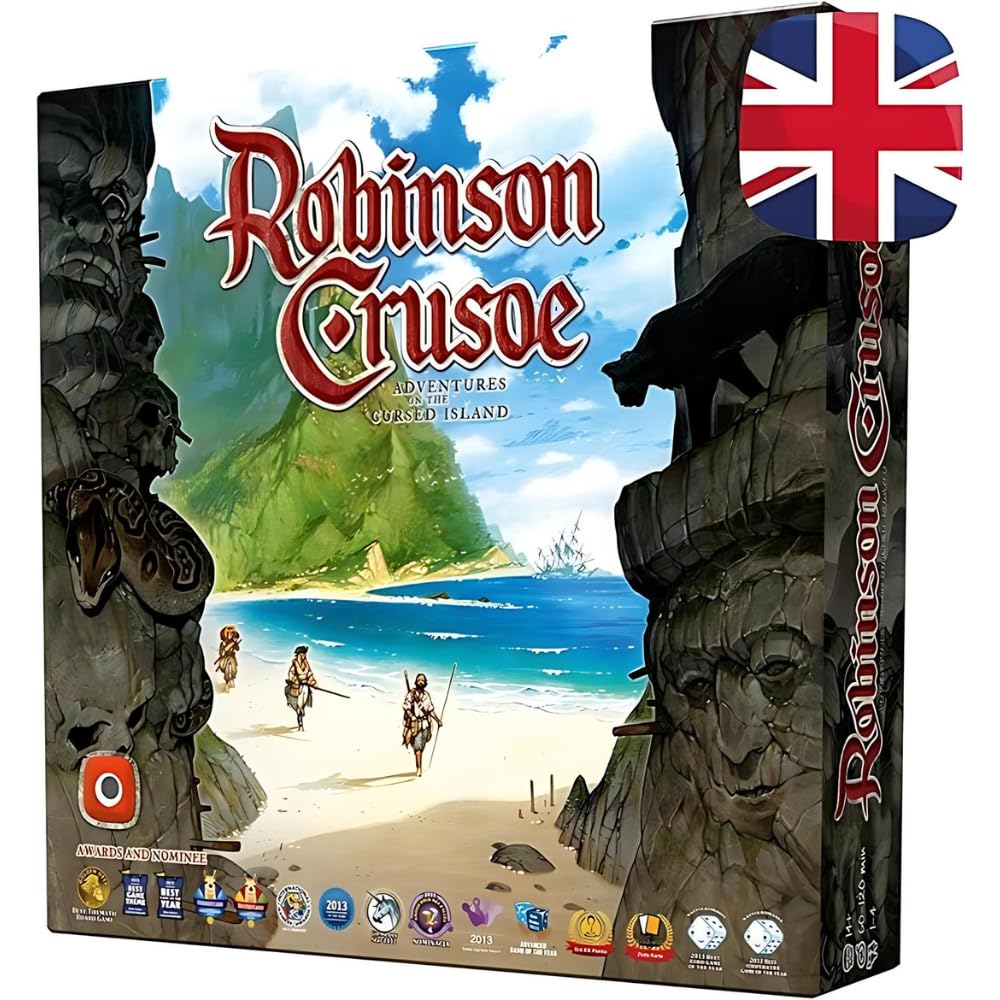
Robinson Crusoe at $54.55 delivers genuine survival storytelling. You're stranded on an island managing resources, building shelters, hunting food, and dealing with escalating threats. Unlike the puzzle-focused games above, this one tells a story through systems. Each scenario has a different objective—sometimes you're just surviving until rescue, sometimes you're hunting treasure or building a boat.
The game includes multiple scenarios that play quite differently from each other. The solo experience involves managing your character's health, hunger, and morale while the island actively works against you. Weather changes, predators appear, illnesses strike. It's genuinely tense because the game doesn't pull punches.
Table footprint is moderate. You need space for an island board (roughly 2x2 feet), your resource tokens, and cards. It's not as compact as Marvel Champions, but it's far from sprawling. Setup takes 10-15 minutes, and games run 1-2 hours depending on scenario difficulty.
This is best for players who want narrative immersion and don't mind games that sometimes kick you while you're down. The difficulty can feel punishing, and some scenarios have brutal luck elements. If you love thematic games where every decision feels weighted with consequence, Robinson Crusoe delivers that.
Pros:
- Multiple distinct scenarios with different narratives
- Strong thematic immersion
- Genuine tension and meaningful decisions
- Good replayability across different scenarios
Cons:
- Requires more table real estate than card games
- Difficulty balance can feel swingy depending on luck
- Rules have some ambiguities requiring judgment calls
- Longer playtime makes solo sessions a commitment
5. Spirit Island — Asymmetric Strategy Depth
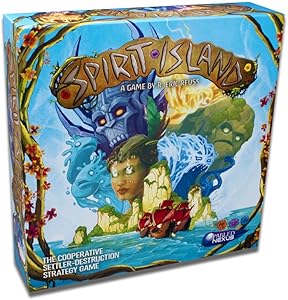
Spirit Island at $58.12 is perhaps the most mechanically ambitious game on this list. You play as spirits defending an island from colonial invaders. But here's what makes it special—each spirit plays by completely different rules. One spirit might move through the land freely while another channels power through the landscape itself. Another focuses on creating fear and terror.
Solo, you control one spirit against an AI-controlled invader deck. The invader mechanics are brilliantly systematic—they expand predictably each turn, so the puzzle becomes "how do I position my powers to maximize disruption?" Different spirits against different difficulty invaders create an enormous variety of strategic puzzles.
The footprint is interesting. The board itself is medium-sized, but the actual components you're actively managing are minimal. Most gameplay happens through cards in your hand and a handful of tokens on the board. It doesn't sprawl chaotically across your table despite the board size.
Spirit Island demands significant engagement. Rules are complex, and each spirit requires learning how they interact with the game engine differently. This is excellent for players who see board games as puzzles to optimize rather than experiences to enjoy passively. Solo play is genuinely compelling because different spirit matchups create entirely different strategic puzzles.
Pros:
- Exceptional strategic depth and replayability
- Each spirit feels genuinely unique
- Elegant core system that accommodates massive complexity
- Excellent solo scaling system
Cons:
- Steep learning curve with complex interactions
- Setup and cleanup are time-consuming
- Rules require careful reading to avoid mistakes
- Can feel like an optimization puzzle rather than a game
How I Chose These
I prioritized games where solo play felt intentional rather than shoehorned in. Many popular board games tack on solo variants that feel like playing against a rulebook. These five games are chosen because the designers clearly thought about the solo experience. I also weighted actual footprint heavily—measuring whether games fit comfortably on a desk, a small coffee table, or during travel. Play time consistency mattered too; I favored games where you can predict session length. Finally, I included variety because solo gaming preferences vary wildly. Some people want puzzle satisfaction, others want narrative immersion, still others want strategic optimization. These five games represent those different motivations while maintaining the small footprint requirement.
Frequently Asked Questions
What's the smallest footprint solo board game here?
The Crew: Quest for Planet Nine wins by a landslide. It literally needs less space than a paperback book. Marvel Champions is second. Both fit comfortably on a desk alongside a laptop. Robinson Crusoe, Mage Knight, and Spirit Island all need a bit more real estate but remain manageable in small spaces.
Can I play these games with other people too?
Yes, though some work better than others. Marvel Champions, Robinson Crusoe, and Spirit Island all play great with 2-4 players, though the experience shifts. The Crew is purely cooperative but designed for 2-5 players (solo is a variant). Mage Knight includes multiplayer rules, though the game balances oddly with multiple players. If you want flexibility, Marvel Champions and Robinson Crusoe are your best bets.
Which one should I buy first?
Start with Marvel Champions if you want quick gratification and easy setup. Pick The Crew if you want maximum value for minimum money. Choose Mage Knight if you already enjoy deep strategy games and want a long-term challenge. Robinson Crusoe works if you prioritize theme and narrative. Spirit Island suits you if you see board games as optimization puzzles.
Do these games go on sale?
Marvel Champions and Robinson Crusoe see occasional Amazon discounts. The Crew is already incredibly cheap. Mage Knight rarely drops in price. Spirit Island discounts appear during major sales but aren't common. Prices listed here are current market rates, but Amazon prices fluctuate.
Finding the best solo board games with small footprint means matching game mechanics to your actual preferences rather than just picking what sounds cool. These five represent genuine quality, and they each deliver something different. Whether you want card game elegance, puzzle satisfaction, narrative tension, or strategic depth, one of these works for your space and play style.
Get the best board game picks in your inbox
New reviews, top picks, and honest recommendations. No spam, unsubscribe anytime.
More in Cooperative
Best Solo Board Games Ever in 2026: Our Top Picks for Playing Alone
Solo board gaming has exploded over the last few years, and if you've been thinking about diving into games you can play by yourself, you're in for a...
Best Solo Board Games with High Replayability in 2026
If you're looking for board games you can play alone without feeling like you're missing out on the experience, you've probably noticed that most games...
Best Compact Solo Board Game 2026: 5 Games That Actually Travel Well
Finding a great solo board game that doesn't require a huge table or an hour of setup is harder than you'd think.