By Jamie Quinn · Updated April 14, 2026
Best Board Games for Christmas Party in 2026


Best Board Games for Christmas Party in 2026
Christmas parties need board games that work for mixed skill levels, keep everyone laughing, and don't require a PhD to learn. I've spent the last couple of years testing games at actual holiday gatherings, and these five stand out because they create real moments—the kind where people forget to check their phones and actually talk to each other.
Quick Answer
Codenames is your best bet for most Christmas parties. It supports 4-8+ players, plays in 15 minutes, and works whether your guests are competitive gamers or haven't touched a board game in years. Everyone understands it immediately, rounds move fast enough that nobody gets bored, and it consistently sparks the kind of laughter that defines a good party.
Our Top Picks
| Product | Best For | Price |
|---|---|---|
| Codenames | Large groups, quick rounds, mixed skill levels | $19.94 |
| One Night Ultimate Werewolf | Chaotic fun, bluffing and accusations | $19.82 |
| Telestrations | Creative people, laugh-out-loud moments | $31.99 |
| Sushi Go Party! | Families or lighter gaming, drafting mechanics | $21.99 |
| Deception: Murder in Hong Kong | Serious players, investigative gameplay | $44.99 |
Detailed Reviews
1. Codenames — The Crowd-Pleaser That Actually Works

If I had to pick one board game for Christmas parties, this is it. Codenames splits your group into two teams trying to identify secret agents using only one-word clues. The magic happens because it's accessible—anyone can play—but still clever enough that good clue-giving actually matters.
Each round takes 15 minutes maximum, which means you can play multiple rounds without anyone feeling trapped. I've watched groups of eight people stay completely engaged for an hour straight, which rarely happens. The game scales beautifully from 4 to 8+ players, so whether you're having an intimate dinner party or a full house, it works.
The real strength here is that it forces conversation and teamwork. You're not staring at your own cards or waiting for your turn while three other people finish their moves. Everyone's thinking the entire time. The competitive element exists but stays friendly—it's hard to get genuinely mad at someone for giving a bad clue.
The downside is that occasionally someone gives a clue that's so obscure nobody gets it, which can kill the momentum. Also, if your group has very different vocabularies, some clues will confuse half the room. But these are minor issues in an otherwise smooth experience.
Pros:
- Plays in 15 minutes, so you can do multiple rounds
- Scales easily from 4 to 8+ players
- Forces everyone to stay engaged throughout
- Dead simple rules that explain in under two minutes
Cons:
- Requires some vocabulary familiarity between teammates
- Less engaging for people who like longer, strategic games
- Can feel repetitive after 4-5 rounds in one sitting
---
2. One Night Ultimate Werewolf — Pure Chaos and Bluffing

One Night Ultimate Werewolf strips away all the downtime that kills other social deduction games. Instead of a 45-minute game where half the players get eliminated and have to watch the rest, this finishes in 10 minutes flat. Everyone plays the entire time.
The setup is straightforward: players get secret roles (werewolf, villager, special abilities), there's a night phase where things happen, then a day phase where everyone accuses each other and votes somebody out. The twist is that roles can change during the night, so you never know who's actually who. Someone might have been the werewolf, then switched to a villager during the night round.
This creates genuine chaos that drives the laughter at parties. People accuse each other based on absolutely nothing, wild theories develop, and someone always makes a bizarre bluff that either saves them or destroys their credibility. I played this with my extended family over Christmas last year and it became the thing people wanted to keep playing instead of opening presents.
The catch is that it rewards reading people and remembering small details, which means experienced players have an advantage. Also, one really dominant personality can sometimes control the entire discussion and eliminate the fun factor. You need a group that's willing to be a little silly and not take the accusations personally.
Pros:
- Games finish in 10 minutes, so you can play 5+ rounds
- Everyone stays engaged throughout
- Creates ridiculous, memorable moments
- Perfect for 4-8 players
Cons:
- Heavily dependent on group dynamics and willingness to banter
- Can feel chaotic if your group prefers organized play
- Experienced players have a real advantage over newcomers
---
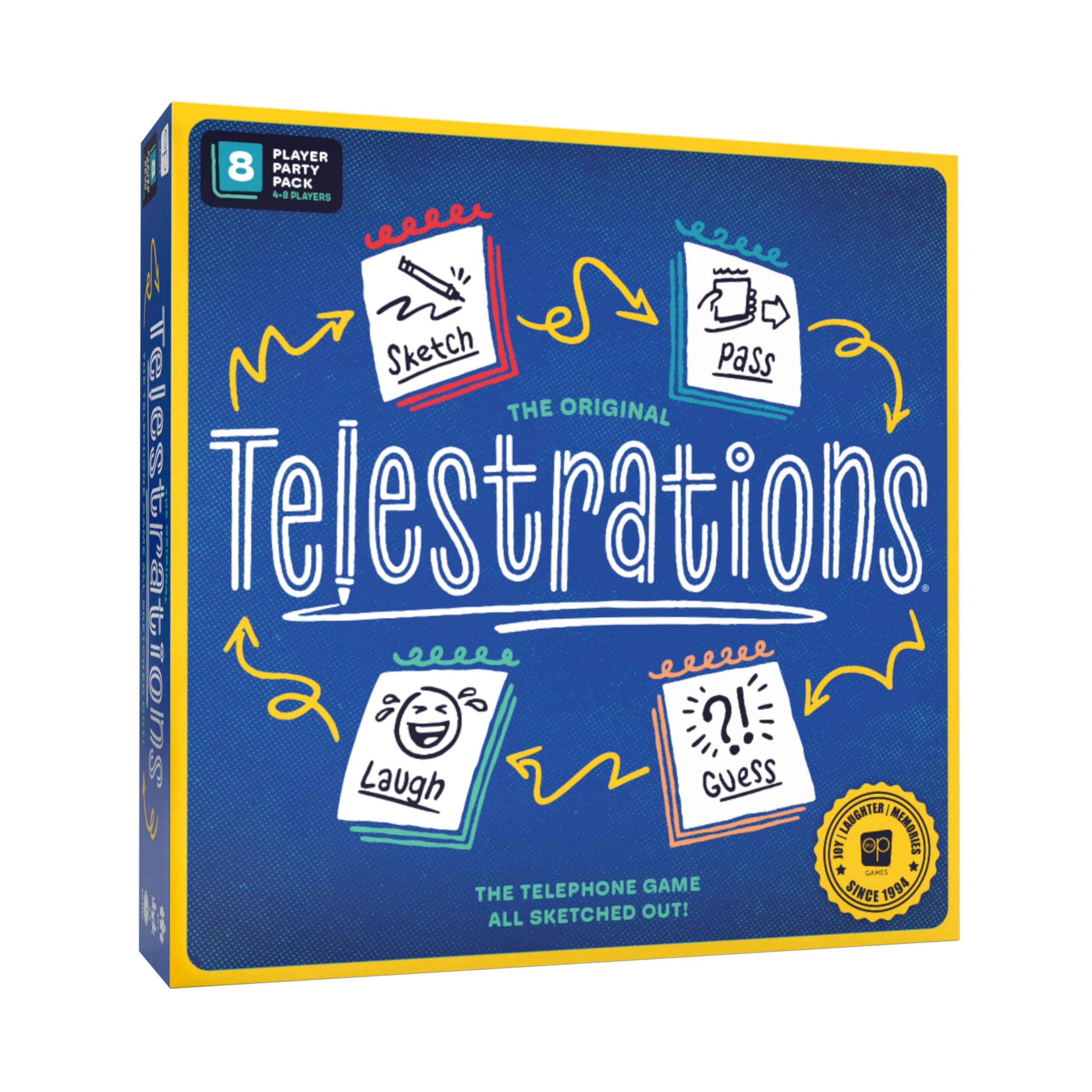
3. Telestrations — Creative, Hilarious, Low-Pressure
Telestrations is telephone mixed with Pictionary, and the results are consistently hilarious. One person writes a phrase, passes it to someone who draws it, passes that to someone who writes what they see, passes that to someone who draws again, and so on. By the end, the final phrase usually bears zero resemblance to the original.
The brilliance is that there's no losing condition. Nobody's trying to be good at art or funny—it just happens naturally through the game mechanics. I've seen people who claimed they "can't draw" get the biggest laughs because their drawings were genuinely confusing in the best ways.
Setup is five minutes, rounds take about 15 minutes each, and it scales from 4 to 12 players easily. Since everyone's creating something, there's no elimination or sitting out. The game rewards creativity and weird interpretation, not competitive skill, which makes it genuinely welcoming to people who don't usually play games.
The limitation is that if your group isn't willing to be playful or everyone takes themselves too seriously, the laughs will be minimal. Also, with really large groups (10+), some rounds can drag because you're waiting for everyone to finish writing or drawing.
Pros:
- No competition, no elimination, everyone stays engaged
- Scales to large groups easily
- Creates genuinely funny moments that people remember
- Super forgiving for non-gamers and non-artists
Cons:
- Requires a group that's willing to be silly
- Can stall with very large groups
- Loses appeal if people are trying too hard to be clever
---
4. Sushi Go Party! — Light, Fast, Accessible Strategy
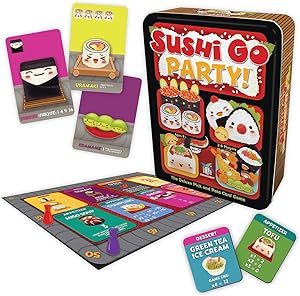
Sushi Go Party! is a drafting game where you're building sushi combos, but it plays like something your grandmother could pick up immediately. Each round, you pick a card and pass your hand to the next player. That's the entire mechanic, but the strategy of knowing what you want versus what you're denying others creates genuine depth.
This works beautifully for board games for Christmas party settings where you want something lighter than heavy strategy but smarter than pure luck. Games finish in 20-25 minutes, so you can get two rounds in during a party. The artwork is appealing without being childish, and teaching the game takes literally one minute.
Where it really shines is with mixed groups. Casual players enjoy the immediate appeal of "I like sushi, let's make combos," while people who think strategically can spend time optimizing their selections. Both groups have fun, just for different reasons. I played this with my in-laws and everyone stayed engaged instead of retreating to their phones.
The downside is that it doesn't create the uproarious laughter of One Night Ultimate Werewolf or Telestrations. It's more satisfying than hilarious. Also, with certain card combinations and player counts, one person can sometimes dominate, which reduces tension in later rounds.
Pros:
- Takes 20-25 minutes per game, quick and repeatable
- Teaches in under two minutes
- Rewards strategy without punishing casual play
- Scales from 2 to 8 players
Cons:
- Less chaotic and funny than party-focused games
- Can lead to one player pulling ahead decisively
- Lighter on social interaction than team-based games
---
5. Deception: Murder in Hong Kong — Serious Investigation for Engaged Groups
If your Christmas party includes people who genuinely want a meaty gaming experience, Deception: Murder in Hong Kong delivers. One player is secretly the murderer, another is the witness who can't speak, and everyone else is a detective. The witness uses tokens and clue cards to point toward the real killer while detectives argue and vote.
This is the most sophisticated game on this list. It plays 4-12 people, takes about 30-45 minutes, and creates real tension. The silent witness role is particularly clever—they're trying to guide without speaking, which feels genuinely challenging. The deduction aspect is satisfying for people who enjoy mystery and logic puzzles.
The conversation it generates is different from other party games. Rather than goofy accusations, people are building cases, analyzing evidence, and actually thinking through suspects. This appeals to Christmas parties where guests skew older or include competitive types who want something with meat on its bones.
Here's the thing though: this is not a board game for every Christmas party. If your guests want something you can jump in and out of, or something that doesn't require focus for 40 minutes, this will feel like work. It's also the most expensive option here, which matters if you're buying multiple games.
Pros:
- Genuinely engaging mystery-solving experience
- Silent witness mechanic is unique and clever
- Scales to large groups without losing quality
- Appeals to people who take gaming seriously
Cons:
- Requires 30-45 minutes and full player attention
- More expensive than the alternatives
- Can feel intimidating if your group prefers casual play
- Less forgiving for players who like quick, light rounds
---
How I Chose These
I selected these specific board games for Christmas party scenarios by weighing a few specific factors. First, playtime: anything longer than 45 minutes feels forced at a party where people want to mingle. Second, player count flexibility—Christmas gatherings are unpredictable, and you need games that work whether 4 people show up or 10. Third, teaching complexity: if it takes 15 minutes to explain the rules, you've lost people before the game even starts.
I also prioritized games that keep everyone engaged simultaneously. Nothing kills a party game like someone being eliminated in round two and spending the next 30 minutes watching. Finally, I tested these with actual mixed groups—not hardcore gamers, but people of varying ages and gaming experience—to make sure they're genuinely accessible rather than just "simple by gamer standards."
---
Frequently Asked Questions
What's the best board game for Christmas party if we have over 10 people?
Codenames and One Night Ultimate Werewolf both scale beautifully to 10+ players, though with larger groups you might want Telestrations since the creative element means bigger groups actually generate more laughs. Deception: Murder in Hong Kong also works well with 10-12 people and creates better investigation dynamics at larger counts.
Can these games work if we have a mix of ages, from kids to grandparents?
Sushi Go Party! is probably your safest bet for truly mixed ages since it's low-pressure and the mechanic is intuitive. Codenames works too if you modify the vocabulary to be universally known. One Night Ultimate Werewolf and Telestrations work great for ages 8+, while Deception: Murder in Hong Kong plays better with ages 12+ since it requires sustained focus and deduction.
Which game should I choose if we only have time for one?
Codenames. It's the most reliable choice for board games for Christmas party settings because it works for any group composition, teaches instantly, plays fast, and stays entertaining across multiple rounds. It's also the cheapest option, so you're not taking a huge risk if your group isn't as into games as you hope.
Do I need to buy multiple games, or will one be enough?
For a single evening, one good game is usually enough if you have 4-8 people. Play 3-4 rounds and move on. If you're hosting a longer event (4+ hours) or expect 10+ people, having two games lets you rotate groups or keep different energy levels happy. The total cost of Codenames plus One Night Ultimate Werewolf is under $40, which is reasonable insurance for a better party.
---
The best board games for Christmas party situations are ones that create moments instead of just filling time. These five handle different group preferences, but if you're hesitant and just want one reliable choice, Codenames checks every box. Get it, learn the rules in two minutes, and you'll have people laughing and competing through multiple rounds without anyone checking the clock.
Get the best board game picks in your inbox
New reviews, top picks, and honest recommendations. No spam, unsubscribe anytime.