By Jamie Quinn · Updated April 27, 2026
The Best Card Games for Every Player Type in 2026




The Best Card Games for Every Player Type in 2026
Finding the best card games means knowing what you actually want to play. Are you hunting for strategic depth, quick party fun, or something the whole family can enjoy without arguments? The card game scene has exploded in the last few years, and what makes a game "best" depends entirely on your group and your time.
Quick Answer
Clank! A Deck-Building Adventure is the best all-around card game because it combines intuitive deck-building mechanics with real tension and exciting gameplay that works for both newcomers and experienced players in about an hour.
Our Top Picks
| Product | Best For | Price |
|---|---|---|
| Clank! A Deck-Building Adventure | Balanced fun and strategy | ~$35–40 |
| Dominion (2nd Edition) | Serious deck-building enthusiasts | ~$40–50 |
| Aeon's End | Cooperative challenge and replay value | ~$45–55 |
| Ashes Reborn: Rise of the Phoenixborn | Competitive, strategic card battler | ~$50–65 |
| Imperium: Classics | Solo or competitive strategic depth | ~$60–75 |
| Exploding Kittens Original Edition | Quick party laughs (2–5 players) | $19.82 |
| Taco Cat Goat Cheese Pizza | Silly group fun (2–8 players) | $8.50 |
| Cover Your Assets Card Game | Social bluffing and light strategy | $19.99 |
| Dutch Blitz: The Original Fast Paced Card Game | Speed and competitive energy | $12.99 |
| Regal Games Card Games for Kids - 6 Set | Family accessibility and variety | $9.99 |
Detailed Reviews
1. Clank! A Deck-Building Adventure — Strategic Theft with Real Stakes

Clank! merges deck-building with a push-your-luck heist theme that keeps everyone engaged from start to finish. You're constructing your deck as the game progresses while simultaneously sneaking through a dragon's dungeon—every card choice matters both for building strength and managing risk. The genius is that your hand directly impacts how much noise you make, which determines whether the dragon notices you. It's tense, fun, and the 60–90 minute playtime never feels long.
Pros:
- Brilliant integration of theme and mechanics—your actions directly tell a story
- Scales well from 2 to 4 players without feeling broken at any player count
- The push-your-luck element creates genuinely exciting moments
- Beautiful art and components feel substantial without being overwhelming
Cons:
- The dragon's behavior is semi-random, which occasionally frustrates competitive players
- Requires more table space than lighter card games
- Takes a few plays to fully optimize strategy
---
2. Dominion (2nd Edition) — The Gold Standard of Deck-Building

If you're serious about card games and want to understand what "deck-building" actually means, Dominion established the entire genre. You start with a mediocre hand and transform it into an optimized engine by buying better cards. The 2nd Edition streamlines the rules from the original while keeping the strategic depth intact. Games last 30–45 minutes, and no two games feel identical because the card market changes with each session.
Pros:
- The foundational deck-building experience—clean, elegant rules
- Enormous replayability with different card combinations
- Quick enough for multiple plays in one session
- Teaches you about card valuation and economic strategy naturally
Cons:
- Less thematic than modern games—it's pure mechanics
- Can feel abstract if you prefer narrative or adventure elements
- The optimal strategy sometimes becomes predictable after 10+ plays
- Doesn't scale as elegantly to 4 players as it does with 2–3
---
3. Aeon's End — Cooperative Intensity Without the Slogfest

Aeon's End asks you and your teammates to defeat a nemesis before it destroys your world. It's cooperative deck-building where you're constructing spell sequences to deal damage. The twist: you control the order your cards play in, which creates a puzzle element that feels genuinely satisfying when solved. Playing 60–90 minutes with friends toward a common goal creates a different energy than competition.
Pros:
- Cooperative tension without the "quarterback" problem (one player dominating decisions)
- Card sequencing creates a real puzzle to solve each turn
- Multiple nemesis options and difficulty levels extend replayability
- Stunning card art and flavor text that actually matters
Cons:
- Playing solo removes much of the collaborative joy
- The difficulty curve can spike unexpectedly
- If your group struggles with analysis paralysis, turns can drag
- Requires card sleeves to protect from wear (not included)
---
4. Ashes Reborn: Rise of the Phoenixborn — Card Game Chess Match

Ashes Reborn is what happens when someone makes a card game that feels like tactical magic duels. You're summoning units, casting spells, and managing resources across multiple turns. Each "Phoenixborn" player brings a unique deck with asymmetrical abilities, which means every matchup feels fresh. Games typically run 45–75 minutes, and the strategic depth rewards repeated plays against the same opponent.
Pros:
- Asymmetrical gameplay keeps learning curves interesting
- Beautiful card design with clear visual hierarchy
- Medium complexity—easier than full competitive CCGs but deeper than party games
- Head-to-head matches create natural rivalries
Cons:
- Requires building specific decks (not a one-box-and-play experience)
- Player imbalance can happen if one person builds a stronger deck
- Less accessible for total newcomers than Clank!
- Limited player base compared to established TCGs
---
5. Imperium: Classics — Deep Strategy in a Portable Box

Imperium Classics is a deckbuilder where you're managing a civilization across multiple rounds, making decisions that compound over time. The "classics" version focuses on historical conflicts rather than fantasy, grounding the experience in something tangible. It plays solo beautifully or as a head-to-head 2-player game, and the strategic decisions feel weighty without requiring constant rule lookups.
Pros:
- Solo mode is as engaging as multiplayer (rare in card games)
- Compact components fit in a bag, making it travel-friendly
- Victory conditions feel earned, not luck-dependent
- Historical theme adds personality to deck-building decisions
Cons:
- Doesn't accommodate more than 2 players (limit by design)
- Solo games can stretch past 90 minutes for new players
- The streamlined ruleset means fewer explosive moments
- Not ideal for casual, turn-your-brain-off gaming
---
6. Exploding Kittens Original Edition — 15 Minutes of Controlled Chaos

Exploding Kittens is pure luck-based party card game fun. You're avoiding cards that will eliminate you while playing "defuse" cards to survive. It's lighthearted, quick, and doesn't require anyone to think strategically. At 15 minutes per round with 2–5 players, it slots perfectly between heavier games or as a gateway game for people skeptical about board gaming.
Pros:
- Super quick setup and playtime
- Rules fit on one card (literally)
- The art is funny enough that people smile just looking at it
- Great icebreaker for groups that haven't played games together
Cons:
- Entirely luck-based—skill doesn't factor in
- Can feel shallow if you play more than 1–2 rounds
- Some players feel eliminated rather than engaged during bad luck streaks
- Not appropriate for competitive players who want agency
---
7. Taco Cat Goat Cheese Pizza — Reflex-Based Party Energy

Taco Cat Goat Cheese Pizza plays like organized chaos: you're cycling through cards while chanting a nonsensical phrase, then slapping the pile when a pattern matches. It's hilarious, physical, and accessible to players aged 2 to 92. The 10–15 minute rounds make it perfect for getting energy back up after a longer game or pure entertainment for casual gatherings.
Pros:
- Incredibly easy to teach—people get it after one round
- Works with 2–8 players
- The phrase itself becomes a running joke your group remembers
- Cheap enough to buy for a white elephant gift
Cons:
- Not strategic in any traditional sense
- If your group hates silly games, skip this completely
- Physical slapping can occasionally lead to arguments about who tapped first
- Wears out quickly (people play it intensely for 20 minutes then move on)
---
8. Grandpa Beck's Games Cover Your Assets Card Game — Bluffing Without Meanness

Cover Your Assets mixes bluffing with light strategy as you build asset stacks while sabotaging opponents. The key mechanic is that your cards stay face-down until revealed, creating moments of genuine surprise without mean-spirited gotchas. It scales from 2–6 players and plays in 20–30 minutes, making it reliable for family game nights where competition shouldn't breed resentment.
Pros:
- Bluffing elements create memorable moments without personal attacks
- Rules are simple enough for ages 7+ to grasp quickly
- Multiple paths to victory prevent runaway leaders
- Great bridge game between party games and strategy games
Cons:
- Some randomness in card distribution can feel unfair early on
- The bluffing becomes predictable after multiple plays
- Doesn't satisfy players looking for deep strategic optimization
- Player elimination isn't possible, which some prefer
---
9. Dutch Blitz: The Original Fast Paced Card Game — Speed and Simultaneous Action
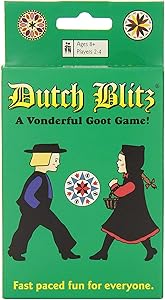
Dutch Blitz is real-time card gaming from the 1950s that holds up remarkably well. You and your opponents are all playing simultaneously, racing to build sequences on shared piles. Everyone has agency at every moment—no waiting for turns. A single round takes 10–15 minutes, but because it's so energetic, people naturally play multiple rounds back-to-back.
Pros:
- Genuinely fast-paced with no downtime for any player
- Simple rules but exciting execution
- Works perfectly for 2–4 players
- Incredibly affordable at $12.99
Cons:
- Requires attention throughout (no spacing out)
- Can feel chaotic if your group dislikes simultaneous play
- The speed can overwhelm players who prefer methodical decision-making
- Scoring tracking is a bit finicky if playing multiple rounds
---
10. Regal Games Card Games for Kids - Go Fish, Crazy 8's, Old Maid, Slap Jack, Garbage Monster, War - Simple & Fun Classic Family Table Games — Six Classics in One Box

This six-game collection teaches the fundamentals while keeping options fresh. Go Fish, Crazy 8's, Old Maid, Slap Jack, Garbage Monster, and War are games every kid should know. The box acts as a training ground before moving into more complex card games, and parents appreciate having multiple options in one purchase.
Pros:
- Introduces card game fundamentals without overwhelming complexity
- Six different games prevent boredom from repetition
- Quality construction holds up to kid-level wear
- At $9.99, it's justifiable even for casual play
- Portable and easy to teach
Cons:
- Adult players will find these simple (that's the point)
- Some games rely entirely on luck (War, Go Fish)
- Doesn't scale to competitive adult play
- The variety paradoxically means less depth per game
---
How I Chose These
Finding the best card games means looking at what actually matters: game mechanics that support the experience they promise, replayability that justifies your investment, and groups they genuinely work for. I evaluated each game on teaching complexity, play time, player count flexibility, and honest limitations. Strategic depth doesn't make a game "better" if your group wants to laugh for 15 minutes instead—context matters. I weighted products that solve different problems rather than picking ten variations on the same idea. The lineup includes competitive games, cooperative experiences, solo options, party games, and gateway titles because "best" depends entirely on what you're actually
Get the best board game picks in your inbox
New reviews, top picks, and honest recommendations. No spam, unsubscribe anytime.
More in Deck Building
The Best Card Games Under $30 in 2026: Fast Fun Without Breaking the Bank
Finding a genuinely good card game shouldn't mean spending $50 or more. I've tested dozens of options, and the best card games under $30 deliver real...
Best Card Games Under $15 for 2026: Fast Fun That Won't Break the Bank
Finding a genuinely fun card game that costs less than $15 feels rarer than it should be.
Best Card Games Under 10: Hidden Gems for 2026 That Won't Break the Bank
Finding quality card games under $10 feels impossible until you know where to look.