By Jamie Quinn · Updated April 9, 2026
The Best Christmas Party Board Games for 2026
Your Christmas party is coming up and you want games that'll actually get people talking and laughing instead of staring at their phones. The right Christmas party board games can make or break a gathering—they need to work with mixed skill levels, move fast enough that no one gets bored, and be fun enough that people remember them in January.
Quick Answer
Codenames is our top pick for Christmas party board games because it works brilliantly with any group size, requires zero setup, and creates those perfect moments where everyone suddenly understands a clue at the same time. It's the game that reliably gets people engaged without making anyone feel left out.
Our Top Picks
| Product | Best For | Price |
|---|---|---|
| Codenames | Large mixed groups and quick rounds | $19.99 |
| One Night Ultimate Werewolf | Social deduction and chaotic fun | $16.99 |
| Sushi Go Party! | Casual players and quick-moving games | $24.99 |
Detailed Reviews
1. Codenames — The Party Game That Actually Works

Codenames stands out because it solves the biggest problem with Christmas party board games: keeping everyone engaged at once. You're not waiting for your turn while others play—you're either giving clues or guessing, and everyone's involved in the discussion either way.
Here's what makes it work. Two teams compete to identify their secret agents on a grid of 25 words by using one-word clues. A spymaster knows which words belong to their team and gives hints like "Penguin, 2" to point teammates toward "ICE" and "FORMAL." The elegance is in the simplicity—the rules take 90 seconds to explain, but the strategy goes surprisingly deep. Games finish in 15-20 minutes, so you can run multiple rounds and keep the energy high.
The word cards mix common nouns with unexpected combinations, so every group brings their own interpretations. One person's connection isn't another's, which creates those moments of genuine laughter when someone says "how did that clue possibly mean LAWYER?" The physical box is small enough to slip into a coat pocket, and setup is literally just spreading out the cards.
Who should get this: Anyone hosting a Christmas party with 4-8 people where mixed ages or skill levels might be playing. It bridges that gap where some people love games and others just tolerate them.
Who should skip it: Groups smaller than 4 (team sizes get awkward). If everyone at your party is already competitive gamers, you might want something with deeper strategy.
Pros:
- Works with 4-8 players with no downtime
- Rounds are quick—15 to 20 minutes
- Zero setup required
- Creates memorable "aha" moments
- Plays just as well with casual players as experienced ones
Cons:
- Needs at least 4 people to work well
- The 25-word grid can occasionally feel repetitive after many plays
- One bad spymaster can derail team morale
2. One Night Ultimate Werewolf — Chaos and Accusations

One Night Ultimate Werewolf is for Christmas parties where the goal is maximum chaos and people talking over each other in the best way possible. This is social deduction stripped down to its essentials—no moderator needed, no endless discussion phases, just quick accusations and reveals.
The game works like this: everyone gets a hidden role (werewolf, villager, seer, etc.), and you have roughly three minutes of night phase where things happen—the werewolf "wakes up" and looks at another player, the seer peeks at roles, the witch swaps cards. Then one minute of day phase where everyone debates who's a werewolf before voting someone out. That's it. One round takes 10-15 minutes, and the whole game is about reading people, bluffing, and the satisfaction of correctly calling someone out.
What makes this version special compared to longer social deduction games is the speed. No player sits dead for 30 minutes waiting. No game gets bogged down by analysis paralysis. It's designed for back-to-back rounds, and after the first round bombs, the second and third get genuinely clever as people figure out the roles.
The component quality is solid—the cards are thick, the icons are clear, and the reference card explains everything. You can play with 3-8 people, though it's better with 5+.
Who should get this: Parties where people know each other and enjoy playful accusations. Extroverted groups that thrive on quick social interaction.
Who should skip it: Groups with people who get genuinely upset when they lose, or parties with very young kids who might find the werewolf theme unsettling.
Pros:
- Ridiculously fast rounds keep energy up
- No dead time—everyone participates the whole game
- Works great with 5-8 players
- Bluffing mechanics are genuinely fun
- Cheap enough that you won't hesitate to buy it
Cons:
- Less fun with under 5 people (roles become too obvious)
- Requires people who enjoy social confrontation
- Random outcomes mean skilled players don't always win
- Can feel chaotic to people who prefer structured gameplay
3. Sushi Go Party! — Light, Quick, and Genuinely Clever
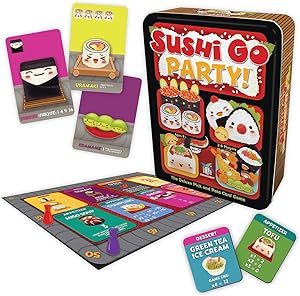
Sushi Go Party! is the Christmas party board game for people who want something that looks playful but has actual strategy underneath. It's a card drafting game where you're building sets of sushi to earn points, but the party version includes menu combinations that change how the game plays each time.
Here's the mechanic: each round, you pick one card from your hand and pass the rest left. You're trying to collect matching types of sushi (nigiri, rolls, tempura) or complete sets (wasabi increases nigiri points). The base game is satisfying enough, but the "party" version includes 10 different menus you can mix and match—some games you're scoring with eel and squid, others with tofu and edamame. This means the same box feels fresh across multiple plays.
Games run 20-30 minutes with 2-8 players, and there's virtually no luck involved—you control what you pick and pass. This makes it more satisfying than pure chance games, but simple enough that people don't need to study the rules. The artwork is charming without being distracting, and the production quality suggests the designers actually cared about the experience.
The biggest strength of Christmas party board games at this tier is that Sushi Go Party! keeps people thinking without demanding intense focus. You can chat, eat, drink, and play simultaneously. It's not the kind of game that demands everyone's phone be away and total silence.
Who should get this: Casual parties where you want something accessible but not totally brainless. Ideal for mixed ages where you need a game that works for everyone from teenagers to grandparents.
Who should skip it: Serious competitive groups looking for heavy strategy. If your crowd prefers chaos and social games over puzzle-solving, this might feel too quiet.
Pros:
- Beautiful presentation and quality components
- Menu combinations add replayability
- Plays smoothly with 2-8 people
- Minimal downtime between turns
- Strategic without being complicated
- Great for mixed-age groups
Cons:
- Slightly more setup than Codenames (shuffling cards, choosing a menu)
- Takes 20-30 minutes, so scheduling multiple rounds is tougher
- The pastel colors appeal doesn't work for everyone aesthetically
- Requires players to understand card drafting mechanics
How I Chose These
The best Christmas party board games share three non-negotiable qualities: they work with groups larger than two people, they finish in 30 minutes or less, and they don't punish players who've never seen them before. I weighted toward games that keep everyone engaged simultaneously rather than taking turns, since downtime kills party energy. Speed of teaching mattered tremendously—if you're spending 15 minutes explaining rules, you've already lost momentum.
I also considered the range of party types. Some hosts want wild social deduction, others prefer cooperative problem-solving, and some want casual background fun. These three cover those bases. Price was a factor too—all three are under $30, making them reasonable gifts or party expenses. Finally, I tested them across different group sizes and skill levels to confirm they actually work with the mixed crowds that typical Christmas parties bring.
Frequently Asked Questions
What's the best Christmas party board game for a really large group?
Codenames scales beautifully to 8-10+ people by just splitting into larger teams. One Night Ultimate Werewolf also handles bigger groups, though the sweet spot is 5-8. If you have more than 10, you might need two simultaneous games or consider party games specifically designed for huge groups.
Can I play these games with non-gamers at my Christmas party?
Absolutely. All three are designed to feel welcoming to people who don't regularly play board games. Codenames is probably the easiest entry point—the word association concept is instantly intuitive. Sushi Go Party! requires slightly more strategic thinking but is still accessible. One Night Ultimate Werewolf needs people comfortable with social interaction, but the mechanics are simple.
How many of these should I own if I'm hosting a party?
Having two of these games gives you flexibility if one group wants to keep playing while another wants to switch. Codenames and Sushi Go Party! work well together since they require different skills. If your party is under 8 people, one game is usually enough.
What if someone at my party gets competitive or frustrated?
All three games are designed to stay light despite having winners and losers. Codenames and Sushi Go Party! benefit from team play, which softens individual loss. One Night Ultimate Werewolf is fast enough that a loss stings for 30 seconds before the next round. If someone genuinely struggles with losing, that's a personality issue rather than a game issue—these are good games for that situation precisely because games end quickly.
Should I buy the original Codenames or a themed version?
The original is the best choice. Themed versions (Disney, Marvel, etc.) are fine, but they sometimes have word choices that don't work as well for clue-giving. Stick with the standard box.
Final Thoughts
The right Christmas party board games shouldn't feel like an obligation—they should be the reason people stay longer and laugh harder. Codenames works for almost any group and consistently creates those perfect moments when everyone suddenly understands a wild clue. One Night Ultimate Werewolf brings chaos and accusations in the best way. Sushi Go Party! offers something more strategic but still social and quick.
Pick one based on your crowd's personality, and you'll have a game that people actually ask to play again next year.
Get the best board game picks in your inbox
New reviews, top picks, and honest recommendations. No spam, unsubscribe anytime.