By Jamie Quinn · Updated March 24, 2026
Best Social Deduction Board Games in 2026: Games That'll Make Your Friends Paranoid





Best Social Deduction Board Games in 2026: Games That'll Make Your Friends Paranoid
Social deduction board games are built on a beautifully simple concept: some players know a secret, others have to figure out what it is, and everyone's trying to read each other's faces. They're the games that turn trust into a weapon and make people question whether their best friend is actually lying about being a werewolf. If you've ever played one and felt that electric tension around the table, you get why these games are so addictive.
Quick Answer
Codenames is the best social deduction board game for most groups. It strips the genre to its essence - two teams, simple rules, pure deduction - and the word-clue mechanic means anyone can jump in. Plus at $24.99, you're getting hundreds of rounds of gameplay for a price that doesn't sting.
Our Top Picks
| Product | Best For | Price |
|---|---|---|
| Codenames | Broad appeal & quick play | $24.99 |
| One Night Ultimate Werewolf | Fast games with paranoia | $19.82 |
| The Resistance | Serious deduction groups | $24.76 |
| Deception: Murder in Hong Kong | Narrative-driven deduction | Price varies |
| Sushi Go Party! | Light social deduction moments | $21.99 |
Detailed Reviews
1. Codenames - The Perfect Gateway to Social Deduction

Codenames works because it respects your intelligence without demanding you remember complex rules. You're a spymaster trying to guide your team to secret agents hidden among a grid of 25 words using only one-word clues and a number. Your teammate hears "movie: 2" and has to figure out which two agents you're signaling. The catch? Some words belong to the opposing team, some to neutral parties, and one is an assassin that ends the game instantly.
What makes this a standout social deduction experience is that it's transparent about what's happening - there's no hidden information hiding on player cards. The deduction happens in real-time conversation. When someone interprets your clue in an unexpected way, you see the exact moment of realization (or confusion) on their face. The game scales beautifully from 2 to 8+ players, and each group develops its own inside jokes about terrible clues from previous rounds.
At $24.99, the price-to-playtime ratio is hard to beat. A single box will give you 200+ games before you exhaust the word cards. If you want something lighter, this slots into family games perfectly since there's zero text to read on game components once you understand the rules.
Pros:
- Incredibly easy to teach - literally 2 minutes of explanation
- Works with any player count from 2 to 10+
- Zero player elimination, so nobody sits out
- Replayability is massive; same words play completely differently with different teams
Cons:
- Not really "deduction" in the mystery-solving sense - it's more about communication and inference
- One quiet or reserved player can slow the game down
- If your group struggles with free-association thinking, clues will feel random
---
2. One Night Ultimate Werewolf - Maximum Paranoia in 10 Minutes

One Night Ultimate Werewolf strips away the slow-burn deduction of traditional werewolf games and replaces it with compressed chaos. Everyone closes their eyes. The werewolves open theirs and acknowledge each other. The seer gets a peek at someone's role. Then you have exactly one night of discussion before voting to eliminate someone - and you don't actually know if the eliminated player was guilty.
This is social deduction at its most frantic. Players are operating on fragments of information and pure intuition. Someone plays the "Troublemaker" role and swaps two players' cards while everyone sleeps, which means even the werewolves aren't sure who's actually on their team anymore. Games finish in 10 minutes, which means you can run three rounds in the time other social deduction board games finish one, and the quick turnarounds let you jump back in immediately.
At $19.82, it's the cheapest entry point on this list. The downside is that it's almost purely social - there's no strategic puzzle to solve, just reading people and taking calculated gambles on accusations. If your group loves long, elaborate arguments about who's suspicious, you might find games end too quickly to build that tension.
Pros:
- Absurdly fast; perfect for parties or filler games between longer games
- Role variety keeps surprises coming even after many plays
- No reading required on cards - roles are simple and visual
- Hilarious when someone's cover gets blown
Cons:
- Outcomes can feel somewhat random; deduction matters less than you'd hope
- Games end abruptly and can leave people mid-argument
- Limited depth compared to other social deduction board games on this list
---
3. The Resistance - The Thinking Player's Social Deduction Game

The Resistance strips away roleplay and theme and leaves you with pure deduction mechanics. Players are either Resistance members or spies. Each round, a team is proposed for a mission. If even one spy is on that team, the mission fails. The Resistance has to figure out who the spies are through conversation and reasoning alone. There are no roles that reveal information, no special powers - just your ability to read people and identify liars.
This is the most exhausting social deduction game on this list, but also the most rewarding if your group enjoys genuine debate. A single round can last 20+ minutes as the table argues about whether Player 3 is definitely a spy or just playing mind games. The information asymmetry is brutal - the spies know each other's identities, but the Resistance members are flying blind. A good spy can manipulate the entire table by subtly supporting innocent teammates, making themselves look trustworthy while sabotaging missions from within.
At $24.76, you're paying for a game that demands your full social and analytical attention. It's not a background game. It's not something you can half-play while talking about something else. Everyone at the table needs to be invested in solving the puzzle, which is both its greatest strength and its most significant limitation.
Pros:
- Incredibly tight deduction mechanics with zero luck
- Spies have real power to influence outcomes through clever play
- Each game tells a story as alliances form and distrust spreads
- Best with experienced players who understand group psychology
Cons:
- Requires 5+ players to work well; smaller groups become predictable
- Can feel exhausting if you're not in the mood for intense social gameplay
- One talkative player can dominate discussion and ruin others' fun
- Not approachable for casual players - this demands serious attention
---
4. Deception: Murder in Hong Kong - The Narrative Deduction Experience

Deception: Murder in Hong Kong trades the group-versus-group tension of other social deduction board games for a different dynamic entirely. One player is the murderer, one is a detective, and the rest are witnesses who suspect everyone. The detective gets clue cards but cannot speak beyond yes-or-no questions. The murderer can speak freely. Everyone else is trying to figure out both the murderer's identity and which evidence points to them.
The asymmetry here is fascinating because information flows in unexpected directions. The detective has to communicate through physical placement of evidence tokens. The murderer has to walk a tightrope between providing helpful clues (which makes them look innocent) and staying silent (which looks suspicious). Meanwhile, the witnesses are spinning narratives based on almost nothing. I've watched groups spend 15 minutes debating whether a token placement was intentional or accidental.
The game plays 4-12 people and keeps everyone engaged the entire time - there's no elimination. Games run 20-30 minutes, making this a solid middle ground between the frantic pace of One Night Ultimate Werewolf and the marathon intensity of The Resistance.
Pros:
- Completely different social deduction format from the other games here
- Detective's communication challenge creates genuine puzzle-solving moments
- Everyone plays the full game; no sitting out or getting voted out early
- Replayability comes from different suspects and evidence combinations
Cons:
- Takes a few rounds to understand what the detective is trying to communicate
- If the detective is too clever, witnesses will miss hints and feel frustrated
- The murderer role is less interesting than detective or witness
- Rulebook can be confusing on first read
---
5. Sushi Go Party! - Light Social Deduction Mixed with Drafting
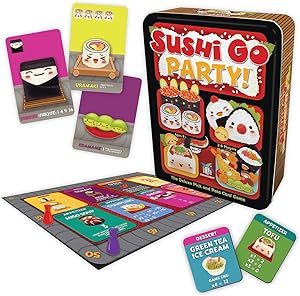
Sushi Go Party! isn't a pure social deduction game - it's a drafting game where reading your opponents becomes the skill layer on top of card selection strategy. You're picking sushi cards to build the highest-scoring meal, but you're also paying attention to what your neighbors are taking, what they're leaving for you, and what they probably want you not to take.
The deduction component is subtle but real. After a few rounds, you learn whether Player 2 always prioritizes desserts or always builds toward tempura combos. You start making choices based on that knowledge - taking cards they want just to deny them, or deliberately leaving bait. A good Sushi Go Party! group develops reads on each other that turn every passing of the card rack into a small psychological game.
At $21.99, this is the lightest social deduction option on the list. It's perfect for groups that want deduction mechanics without the intense social pressure. Games run 30 minutes and the rules are incredibly simple. If you're looking for something that works as family games and also rewards reading your opponents, this is your pick. But if you want pure deduction focus, this won't scratch that itch the same way Codenames or The Resistance will.
Pros:
- Accessible entry point to games where reading opponents matters
- Beautiful artwork and satisfying card collection feeling
- Works great with mixed skill levels
- Plays quickly and keeps everyone engaged
Cons:
- Social deduction is a secondary layer, not the main game
- Less direct confrontation than pure social deduction board games
- New players won't understand the mind-game layer for their first few games
- Luck of the draw can sometimes overpower good strategy
---
How I Chose These
I picked these five social deduction board games based on what actually happens when different groups play them. I weighted three factors equally: mechanical uniqueness (so you're not just playing the same game with different theming), scalability (how many player counts does it handle?), and teachability (can you explain it to new players without taking 15 minutes?). I included games from both ends of the intensity spectrum - One Night Ultimate Werewolf and Codenames for casual groups, The Resistance for competitive players who want psychological warfare, and Deception for groups that like narrative tension. I excluded social deduction games that require a large player minimum (like Mafia variants that only work at 8+) or games where theme overshadows mechanics. Price was a factor in recommendations but not in selection; all five of these games deliver measurable value.
Frequently Asked Questions
What's the difference between social deduction board games and party games?
Social deduction games specifically require you to figure out hidden information about other players through conversation and observation. Party games like charades are about communication but don't have deception as a core mechanic. Most social deduction board games work as party games, but not all party games involve deduction.
How many players do I need for social deduction board games?
It depends on the specific game. Codenames works great with 2 players. The Resistance wants 5+. One Night Ultimate Werewolf is best at 6-10. If you have a consistent group size, pick a game designed for that count - social deduction games don't always scale smoothly.
Can I play these with people who aren't "gaming types"?
Yes. Codenames and One Night Ultimate Werewolf require almost no board game literacy. Sushi Go Party! and Deception are close behind. The Resistance requires players who are willing to engage in social gameplay, so save that one for groups where everyone's on board.
Are these games better with experienced players?
Social deduction board games improve dramatically when players understand group psychology and bluffing strategy. That said, all five of these are fun the first time you play them, even without experience. The Resistance and Deception reveal more depth on replays, while Codenames and One Night Ultimate Werewolf are equally fun whether it's your first or fiftieth game.
---
Social deduction board games sit at the intersection of strategy and social gameplay - they're only as good as the people around your table. Codenames is the safest pick if you're building your first collection, while The Resistance will satisfy groups hungry for real psychological depth. One Night Ultimate Werewolf keeps things moving if you want multiple games in one session. Deception offers something different for groups tired of the standard "secret role" formula. Pick the one that matches your group's personality, and you'll have something people actually want to play.
Get the best board game picks in your inbox
New reviews, top picks, and honest recommendations. No spam, unsubscribe anytime.
More in Party
Best Party Board Games for Large Groups in 2026
Planning a game night for 8+ people? Finding the right board game that actually works for large groups is trickier than it sounds.
Best Trivia Games to Play With Friends in 2026
You're gathering friends for game night, and you want something that gets everyone talking, laughing, and actually engaged—not something that turns into a...
Best Popular Trivia Games for Group Settings in 2026
Group game nights can be hit or miss—either everyone's engaged and laughing, or half the table is checking their phones.