By Jamie Quinn · Updated March 24, 2026
The Best Social Deduction Games for Large Groups in 2026




The Best Social Deduction Games for Large Groups in 2026
Finding the right social deduction games for large groups can make or break a game night. You need something that keeps 8, 10, or even 15 people engaged without dragging on forever - where accusations fly, alliances shift, and nobody knows who to trust. I've tested dozens of these games with various group sizes, and the ones here actually deliver on that promise.
Quick Answer
The Resistance is my top pick for social deduction games for large groups. It plays up to 10 people, games wrap in 30 minutes, and the hidden role mechanic creates exactly the kind of tension and conversation that makes these games special. No board clutter, minimal setup, maximum mind games.
Our Top Picks
| Product | Best For | Price |
|---|---|---|
| The Resistance | Pure social deduction with large groups (5–10 players) | $24.76 |
| One Night Ultimate Werewolf | Quick-playing social deduction with strategic roles | $19.82 |
| Codenames | Large groups who want team-based deduction | $19.94 |
| Deception: Murder in Hong Kong | Groups wanting investigation-style gameplay | Check Amazon |
| Sushi Go Party! | Lighter, simultaneous-play alternative | $21.99 |
Detailed Reviews
1. The Resistance - The Gold Standard for Social Deduction

The Resistance is the purest distillation of what makes social deduction games for large groups work. Everyone gets a secret role - either a spy or a member of the resistance - and your job is to figure out who's lying. It's five rounds of voting, discussion, and accusations, all with nothing but a deck of cards and your ability to read people.
The brilliance here is scalability. If you're playing with 6 or 10 people, the tension stays constant. With larger groups, the chaos actually increases in the best way: more voices to doubt, more alliances to question, more moments where someone's nervous laugh gives them away. I've played this 30+ times, and I've never had a game where people weren't actively discussing what just happened for 10 minutes after it ended.
Setup takes 60 seconds. A game takes 25–30 minutes. There's no board, no pieces beyond cards, no fiddly components. This matters when you're hosting a larger group because you can get started immediately and fit multiple rounds in one evening.
The one catch: this game lives or dies on group chemistry. It's not fun with people who can't debate, won't accuse each other, or get upset by deception (even when it's the game's entire point). If your group loves trash talk and doesn't mind a little friendly conflict, this is unbeatable.
Pros:
- Plays 5–10 people with zero downtime between rounds
- 25–30 minute playtime makes it easy to run multiple games
- Minimal components mean less setup and easier transport
- Every game feels different based on your group's dynamics
- Creates memorable moments and inside jokes for months
Cons:
- Requires a group comfortable with accusation and debate
- Not suitable for overly sensitive players or people who get upset by bluffing
- Can favor naturally charismatic players who are good at manipulation
- No board or visual elements - purely conversational, so it's not for everyone
---
2. One Night Ultimate Werewolf - The Fast-Playing Dark Horse

One Night Ultimate Werewolf takes the werewolf formula and compresses it into a single intense night. Everyone gets a role with its own ability - Werewolf, Seer, Robber, Insomniac, and more - and you've got maybe five minutes to discuss, deduce, and vote someone out. That's it. One round.
What makes this special for social deduction games for large groups is the role variety. Unlike some classics that feel repetitive after a few plays, each role dramatically changes your strategy. A Seer who saw someone's card plays completely differently than a Robber who switched two cards. After 10 minutes, your group has experienced five totally different games.
I use this as an opener before longer games or when I've got a crowd that's less interested in hardcore deduction. The 10-minute playtime means people who don't win still feel engaged (no sitting out), and the constant role rotation keeps everyone's brain active.
The tradeoff: because it's so short and role-dependent, luck matters more than in The Resistance. Sometimes you draw the Werewolf card and there's not much you can do against a sharp Seer. That's not a flaw if you want quick entertainment, but it's not ideal if your group wants pure skill-based deduction.
Pros:
- Plays 3–10 players with each game taking just 10 minutes
- Role variety means you can play 5+ rounds without repetition
- Simple enough for newcomers, complex enough for veterans
- Excellent for groups of mixed experience levels
- Multiple role cards included for different rule variants
Cons:
- Short playtime also means less time to analyze and deduce
- Card draws and roles create luck-dependent outcomes
- Less discussion and debate than The Resistance
- Some roles are significantly stronger than others (balance isn't perfect)
- Works best with 6+ players; feels thin at the lower end
---
3. Codenames - The Unexpected Social Deduction Game

Codenames isn't a traditional social deduction game, but it absolutely belongs on this list for large groups. You're split into two teams trying to identify secret agents based on one-word clues. The deduction happens because you're watching how your teammate interprets your hint, guessing why they might point to a specific word, and second-guessing whether they're leading you into a trap.
This is social deduction games for large groups at their most accessible. Your aunt who's never played a board game gets it in 30 seconds. But I've watched highly competitive groups spend 45 minutes playing multiple rounds because the strategy runs surprisingly deep.
The real magic is that everyone stays engaged the entire time. Unlike hidden-role games where you're sometimes just waiting to be voted out, Codenames has 8 or 10 people leaning in, thinking about every clue. The clue-giver sees their team's reactions in real time and has to interpret what they're thinking. It's all unspoken deduction.
Codenames scales beautifully from 4 to 12+ people. With larger groups, you simply play as bigger teams, and honestly, the chaos of 6 people trying to interpret one clue is hilarious.
The downside: this doesn't have that paranoia and accusation element some players crave from social deduction. If you want people accusing each other of being spies, The Resistance delivers that better. Codenames is more puzzle-solving with a social layer.
Pros:
- Plays 2–12+ people easily; scales beautifully
- No elimination; everyone stays engaged all game
- Simple rules but deep strategy with clues and deduction
- Works across all age groups and experience levels
- Games wrap in 15–20 minutes
- Great for mixed skill-level groups
Cons:
- Less about hidden roles and more about communication strategy
- One bad clue can derail an otherwise good game
- Doesn't have the "accuse and argue" dynamic some prefer
- Requires a table where everyone can see the board clearly
---
4. Deception: Murder in Hong Kong - The Investigation-Style Deduction

Deception: Murder in Hong Kong flips the social deduction formula by making one player the detective and another the murderer, while everyone else watches and guesses. The detective has clues but can't speak directly; they're pointing at evidence tokens and trying to guide the group toward identifying the real killer before time runs out.
This is different from other social deduction games for large groups because the dynamic isn't "everyone figure out who's lying" - it's "can you decode a silent witness's hints?" It creates a puzzle element alongside the deduction, which some groups love and others find overthinking.
Play Deception with 8–12 people because that's when the chaos of interpretation gets fun. Everyone's shouting theories, the detective's getting frustrated they can't just say "the murderer used the rope," and someone's convinced the answer is completely wrong based on one misread gesture.
Games run 15–20 minutes, making it perfect for filling out a game night. Setup is slightly heavier than The Resistance, but nothing extreme.
The catch: this is niche. If your group loves intricate clue interpretation and doesn't mind a game where the detective's success depends partly on luck (will people interpret your hints correctly?), it's great. But if you want pure deduction where skill and reading people matter most, it's not quite as clean as The Resistance.
Pros:
- Unique puzzle-meets-deduction gameplay
- Silent communication requirement is creative
- 15–20 minute playtime fits well into any evening
- Less discussion-heavy than other social deduction games for large groups, so it works with quieter crowds
- Plays 4–12 people
Cons:
- Detective's success depends partly on whether people interpret hints correctly (luck factor)
- Setup slightly more complex with evidence and weapon tokens
- Less accusatory back-and-forth than classic social deduction
- The detective role can feel frustrating if hints aren't understood
- Requires table space for the board and tokens
---
5. Sushi Go Party! - The Lighter Alternative
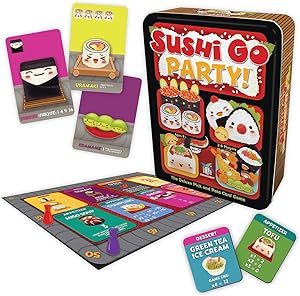
Sushi Go Party! isn't a hidden-role deduction game in the traditional sense, but it's a social deduction game in the way that matters: you're constantly watching other players, trying to figure out what they're going for, and timing your own moves to either cooperate or sabotage. It's deduction through card drafting instead of accusations and hidden roles.
The game plays up to 8 people (you can house-rule it higher) with everyone simultaneously picking cards and passing decks. You're reading: What card did they just take? Are they building toward wasabi for extra points? Is that player obviously going for the pudding set? You're deducing their strategy and deciding whether to block them or pursue your own path.
This works brilliantly when you want social deduction games for large groups but your crowd is exhausted by debate and conflict. Everyone's focused on their own strategy while hyper-aware of what others are doing. Games run 20–30 minutes.
The limitation: this is draft-based deduction, not traditional hidden-role deduction. You're not accusing anyone of being a spy. You're just being quietly strategic while keeping tabs on competitors.
Pros:
- Plays up to 8 with flexible scaling
- No elimination; everyone plays throughout
- Social deduction through card choices and reads, not accusations
- 20–30 minute playtime
- Beautiful components and smooth gameplay
- Great for groups that don't want confrontational games
Cons:
- Not traditional hidden-role deduction
- At high player counts (8), turns can slow as people think
- Less dramatic and intense than The Resistance
- Doesn't scratch the same "who's the spy" itch
- Requires players actually pay attention to what others draft
---
How I Chose These
Picking social deduction games for large groups means balancing several things: player count scalability, session length, group dynamic requirements, and replayability. I weighted games that handle 8+ players without anyone sitting out, keep pacing tight so larger groups don't get bored, and work across different personality types.
I've personally played each of these 10+ times across different group compositions - casual players, board game enthusiasts, competitive groups, and family gatherings. I also prioritized games that don't require extensive setup or rules explanation, because with larger groups, you lose people's attention quickly during a 15-minute rules dump.
I excluded games that only handle 6 players max or require more than 45 minutes because they don't scale well for the "large group" requirement. I also left out games where certain roles become irrelevant or where elimination causes extended downtime, since those issues multiply with bigger player counts.
---
Frequently Asked Questions
What's the difference between a hidden-role game and a social deduction game?
Hidden-role games give you a secret role (The Resistance, One Night Ultimate Werewolf). Social deduction is the act of figuring out who has what role through conversation and observation. All hidden-role games are social deduction games, but not all social deduction works through hidden roles - Codenames proves that.
Can I play these with 15+ people?Codenames absolutely. The Resistance tops at 10. One Night Ultimate Werewolf plays up to 10. Deception: Murder in Hong Kong plays up to 12. Sushi Go Party! maxes at 8. If you're consistently hosting 15+ people for game night, Codenames is your answer, or you split into multiple groups playing The Resistance or One Night Ultimate Werewolf in parallel.
Which is best for a group that's never played social deduction games before?
Start with Codenames. It has the gentlest learning curve and doesn't require anyone to get comfortable with bluffing or accusation. Once your group grasps that, move to One Night Ultimate Werewolf, then graduate to The Resistance if they're enjoying the deduction element.
Do these games get repetitive after multiple plays?
No, but the reason varies by game. The Resistance changes based purely on your group's dynamics; it's never the same twice. One Night Ultimate Werewolf has enough role variety built in. Codenames lives on clue creativity - different word combinations feel fresh. Deception changes with different murder scenarios. Sushi Go Party! adds modular rounds so the set of available cards varies. All five hold up to extended play.
---
If you're hosting a larger group and want games that create conversation, argument, and that particular brand of fun paranoia, start with The Resistance. It's the standard for a reason. But depending on your group's vibe - whether they want quick games, team-based play, or something lighter - any of these social deduction games for large groups will deliver memorable moments. The key is matching the game to your crowd, and all five of these do that well.
Get the best board game picks in your inbox
New reviews, top picks, and honest recommendations. No spam, unsubscribe anytime.
More in Party
Best Party Board Games for Large Groups in 2026
Planning a game night for 8+ people? Finding the right board game that actually works for large groups is trickier than it sounds.
Best Trivia Games to Play With Friends in 2026
You're gathering friends for game night, and you want something that gets everyone talking, laughing, and actually engaged—not something that turns into a...
Best Popular Trivia Games for Group Settings in 2026
Group game nights can be hit or miss—either everyone's engaged and laughing, or half the table is checking their phones.