By Jamie Quinn · Updated April 14, 2026
Best Strategy Board Games 2026: Five Deep Picks for Serious Players



Best Strategy Board Games 2026: Five Deep Picks for Serious Players
Finding the right strategy board game can be frustrating—you want something that actually challenges your brain, doesn't take four hours to explain, and holds up after dozens of plays. I've spent the last few years testing dozens of games, and the best strategy board games 2026 have one thing in common: they reward thoughtful planning without requiring a PhD in game theory to enjoy.
Quick Answer
Terraforming Mars is my top pick because it combines accessible ruleset with incredible depth, scales beautifully from 1 to 5 players, and gives you something genuinely different to think about every single game. You're managing resources, timing card plays, and competing for dominance on Mars—it scratches multiple strategic itches at once.
Our Top Picks
| Product | Best For | Price |
|---|---|---|
| Terraforming Mars | Solo play and varied player counts; replayability | $63.37 |
| Brass: Birmingham | Economic simulation and player interaction | Check Amazon |
| Imperium: Classics | Compact strategy with minimal setup | $34.85 |
| Undaunted: Normandy | Card-driven tactical gameplay; two players | $44.52 |
| Gaia Project | Heavy engine building and space exploration | Check Amazon |
Detailed Reviews
1. Terraforming Mars — Best for Replayability and Solo Play
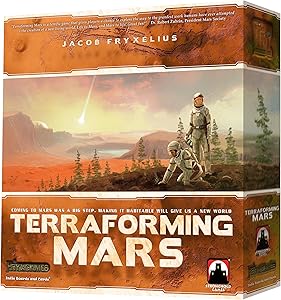
Terraforming Mars does something that most strategy board games 2026 struggle with: it makes you feel like you're actually accomplishing something meaningful while still requiring genuine tactical decisions. You're developing corporations, playing cards to terraform the Martian surface, and racing against other players for oxygen, temperature, and ocean coverage milestones.
The card pool is massive (over 200 unique cards in the base game), which means nearly every playthrough feels fresh. I've played this game probably 80 times now, and I still encounter card combinations I haven't seen before. The economy of the game is tight—you're always spending your production budget on something you'd rather spend on something else. That constant tension is what keeps it interesting.
The solo variant deserves special mention. Playing against the automated opponent teaches you the core strategy faster than multiplayer because you can focus on your own engine without table politics interference. It's genuinely one of the best solo experiences in modern board gaming.
Pros:
- Incredible card variety ensures different strategies work across different games
- Solo mode is engaging and teaches strategy naturally
- Scales well from 1 to 5 players without feeling broken at any player count
- Corporate asymmetry means you can't just copy the same strategy every game
Cons:
- Setup and teardown takes 10-15 minutes; not a quick setup
- The rulebook could be clearer on a few interactions—expect to Google something once or twice
- Analysis paralysis can hit experienced players hard; someone will take 10 minutes on their first card play
---
2. Brass: Birmingham — Best for Economic Strategy and Player Interaction

Brass: Birmingham is the game you play when you want to feel like you're outmaneuvering actual human opponents. This isn't a multiplayer solitaire experience—your decisions directly affect everyone else at the table, and everyone knows it.
You're building an industrial network during the canal and railway eras of Birmingham. Every action you take has ripple effects: building a factory opens up opportunities for someone else, but blocking them from a location costs you connection points. The game forces you to balance being aggressive without being so aggressive that everyone teams up against you.
What separates Brass: Birmingham from other economic games is the scoring system. You don't count points continuously; you score at the end of each era, which means the entire board state flips multiple times during a game. A player who's crushing it in round one can suddenly find themselves out of position when the rules shift. This prevents the runaway leader problem that kills some strategy games.
The network building mechanic is elegant. You're literally drawing on a map, and you want your network to connect in ways that create value. It's satisfying in a way that abstract point-shuffling never is.
Pros:
- Direct player interaction without being mean-spirited
- Map-based network building creates tactile satisfaction
- Scoring shifts prevent snowballing problems
- Every decision matters; very few throwaway turns
Cons:
- Can feel overwhelming on your first play; the hand management system takes explanation
- Playing time edges toward two hours with experienced players
- The strategy is deep enough that lucky card draws won't save you—newer players might feel outmatched
- Not as flexible in player counts; best at 3-4 players
---
3. Imperium: Classics — Best for Portable Strategy
Imperium: Classics is proof that you don't need a massive board, fifty tokens, and a reference sheet longer than a novel to create genuine strategic depth. This is a card-driven civilization game that fits in your backpack and teaches in five minutes.
Each player gets a personal deck of cards representing their empire. You're acquiring new technologies, managing your population, and expanding your territory—but everything you do with cards literally gets shuffled back into your deck. This creates a beautiful feedback loop where your early decisions directly impact what options you have in the future.
The game plays in roughly 45 minutes with two players, which makes it perfect for the strategy gamer who doesn't have an entire evening available. You're thinking multiple turns ahead because your deck composition is your strategy. Want to focus on military? Your early card choices reflect that. Want economic dominance? Build differently.
Imperium: Classics is designed for head-to-head play, and it shines there. If you're looking for best strategy board games 2026 that travel well and teach quickly, this is your answer.
Pros:
- Compact and portable; fits in a small box
- Quick teach and 45-minute playtime appeals to players with limited time
- Deck-building strategy emerges naturally from gameplay
- Asymmetrical starting positions mean players pursue genuinely different strategies
Cons:
- Really only designed for two players; it exists in a larger series if you want multiplayer
- The card text is small; aging eyes might struggle
- Less replay variance than some other games because the card pool is intentionally limited
- If you don't like head-to-head competition, this isn't for you
---
4. Undaunted: Normandy — Best for Tactical Card Play
Undaunted: Normandy is a two-player tactical game where your deck IS your military force. You're drawing cards to deploy soldiers, move units, and execute attacks in World War II scenarios. It sounds straightforward, but the decision space is genuinely impressive.
Every card in your deck serves multiple purposes. That squad card can either deploy soldiers or move existing units—you're choosing which based on your current situation. Your opponent is doing the same, and you're trying to outsmart them without knowing what's in their hand. It's bluffing without bluffing, strategy without perfect information.
The campaign system adds incredible replayability. You play through linked scenarios where casualties from one game carry forward to the next. It creates genuine tension because losing soldiers isn't just a setback in this game; it affects your deck composition in the next one.
If you're into two-player games, this should be on your radar. It's not a peaceful euro game or a crunchy economic sim—it's direct, tactical, and punishing in the best way.
Pros:
- Card deck as literal military force is mechanically brilliant
- Campaign system creates emergent narrative across multiple games
- Excellent scenario design with meaningful tactical decisions
- Two-player only means zero downtime—you're engaged the entire game
Cons:
- Only works for two players; completely unscalable
- Scenario setup requires attention to detail; misreading terrain rules breaks the game
- Luck of the draw can swing games dramatically on occasion
- If you prefer cooperative or multiplayer gaming, skip this
---
5. Gaia Project — Best for Heavy Engine Building

Gaia Project is for players who want to build an interstellar civilization and don't mind spending two to three hours doing it. This is a heavyweight strategy game that demands your full attention but rewards it with one of the most satisfying engine-building experiences available.
You're managing a unique alien faction with asymmetrical powers, expanding across a hexagonal galaxy, and competing for control. Each faction has completely different mechanics—one faction spreads through the galaxy freely while another is locked into their home sector but gains bonuses. These aren't cosmetic differences; they fundamentally change how you approach the game.
The tech tree interaction is where the real strategy lives. You're not just researching technologies; you're researching them in a specific order because later technologies build on earlier ones. An opponent's tech choice affects your optimal path, which affects their next decision. It creates a chain reaction of strategic interdependence.
This is absolutely one of the best strategy board games 2026 for players who want maximum depth and don't care about snappy playtime.
Pros:
- Faction asymmetry is genuinely game-changing; not just flavor
- Tech tree progression creates satisfying engine building
- Modular board keeps the game feeling fresh across replays
- The economy system is elegant despite the heavy theme
Cons:
- Learn-to-play time is substantial; expect 30-40 minutes before the first actual game turn
- Two to three hours is standard; plan accordingly
- Analysis paralysis is a real risk with experienced players
- Setup is involved; not a "grab and play" game
---
How I Chose These
I evaluated these games across five criteria: decision quality (does every choice matter?), replayability (does it feel genuinely different in subsequent plays?), player count flexibility (does it work well across different player counts, or is it purpose-built?), teach-ability (can a new player understand what they're doing after one explanation?), and longevity (will this still be fun after 20+ plays?).
I weighted replayability and decision quality heavily because those are what separate "good game you play once" from "game you keep coming back to." Theme matters less than mechanics, but I prioritized games where the theme actually supports the mechanics rather than fighting against them.
---
Frequently Asked Questions
What's the difference between best strategy board games 2026 and heavier strategy games?
Strategy board games emphasize decision-making and planning, but the best ones from 2026 also respect your time. They're not necessarily simpler—Brass: Birmingham has incredible depth—but they're designed so you're playing the game, not reading rules. Heavier games might demand more minutes per turn, but lighter strategy games teach faster.
Can I play these games solo?
Terraforming Mars has a dedicated solo mode that's excellent. Undaunted: Normandy works fine solo against yourself. The others are better with opponents, though Gaia Project has a solo variant if you dig deep. If solo gaming is your main interest, Terraforming Mars is your pick.
How long do these games actually take?
Terraforming Mars: 60-90 minutes. Brass: Birmingham: 90-120 minutes. Imperium: Classics: 45 minutes. Undaunted: Normandy: 45-60 minutes per scenario. Gaia Project: 120-180 minutes. All times assume players who know the rules.
Which game is best for new strategy gamers?
Start with Terraforming Mars or Imperium: Classics. Terraforming Mars teaches the fastest relative to its depth—nobody struggles with understanding what they're doing. Imperium: Classics is even simpler mechanically but more limited in scope. Both are far more accessible than Brass: Birmingham or Gaia Project.
---
If you're serious about strategy gaming in 2026, these five games cover different niches: replayable depth (Terraforming Mars), economic interaction (Brass: Birmingham), portability (Imperium: Classics), tactical play (Undaunted: Normandy), and heavyweight engine building (Gaia Project). You can't go wrong starting with any of them, but Terraforming Mars remains the safest recommendation because it genuinely works well at any player count and never gets old.
Get the best board game picks in your inbox
New reviews, top picks, and honest recommendations. No spam, unsubscribe anytime.
More in Strategy
The Best Engine Building Games of 2026: 5 Excellent Choices That Actually Deliver
Engine building games are genuinely addictive because they give you that satisfying progression feeling—you start with almost nothing, then gradually...
Best Euro Games for Kids in 2026: Top Picks for Family Game Night
Euro games—those elegant, strategy-focused board games from European designers—are perfect for kids who want more than dice-rolling luck.
The Best Strategy Board Games for 6 Players in 2026
Finding the right board game for exactly six players is trickier than it sounds. Too many games max out at four or five, forcing awkward house rules.