By Jamie Quinn · Updated April 13, 2026
The Best Strategy Game to Play in 2026: Our Tested Picks




The Best Strategy Game to Play in 2026: Our Tested Picks
Finding the best strategy game to play depends on what you actually want from your gaming table. Some people crave deep economic systems, others want tactical combat, and some just want something they can teach to non-gamers. I've spent the last few years testing strategy games with different groups—from hardcore hobbyists to casual players—and the games that stick around are the ones that balance meaningful decisions with reasonable play time.
Quick Answer
Terraforming Mars is the best strategy game to play if you want depth, replayability, and that satisfying "one more game" feeling. It combines a strong theme with genuinely tough resource management decisions, plays 1-5 people, and every session feels different thanks to rotating cards. Even at $63.37, it's the game that gets requested most often at my table.
Our Top Picks
| Product | Best For | Price |
|---|---|---|
| Terraforming Mars | Deep strategy, replayability, engine-building | $63.37 |
| Brass: Birmingham | Economic strategy, player interaction, investment games | Check Amazon |
| Gaia Project | Hard sci-fi, spatial strategy, 2-4 serious players | Check Amazon |
| Undaunted: Normandy | Two-player tactical combat, historical interest, card-driven mechanics | $44.52 |
| Imperium: Classics | Solo play, deck-building strategy, historical themes | $34.85 |
Detailed Reviews
1. Terraforming Mars — The Modern Classic for Strategy Lovers
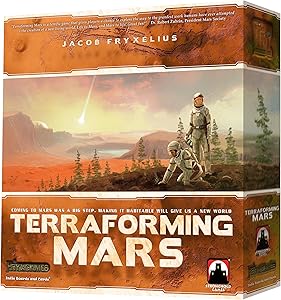
Terraforming Mars hits that rare sweet spot where you have meaningful decisions every turn but the game still finishes in a reasonable timeframe (around 90 minutes once you know what you're doing). You're playing as corporations competing to terraform Mars, and your choices ripple across the board through temperature changes, ocean placement, and oxygen levels. No two games feel identical because the card pool shifts with each play.
What makes this the best strategy game to play for most people is how it teaches itself. The first game feels chaotic, but by round three you'll understand why blocking an opponent's oxygen tile matters or why terraform rating is precious. The engine-building aspect—where your corporations become more efficient and synergistic—scratches an itch that casual strategy games just don't reach.
The solo mode is genuine, not tacked-on. If you play alone, you're competing against a specific terraform target, which means this game works just as well on a Tuesday night by yourself as it does at a table of five.
Pros:
- Incredible replayability thanks to rotating card pool and modular expansions
- Meaningful player interaction without being cutthroat
- Satisfying engine-building that rewards planning ahead
- Solo mode is legitimate and engaging
Cons:
- First 20 minutes involve a learning curve
- Card quality in base game could be better (upgrades exist)
- Quarterbacking can happen with groups that don't self-regulate turns
- Takes longer with 4-5 players (expect 2+ hours)
2. Brass: Birmingham — Economic Strategy That Actually Feels Real

Brass: Birmingham is the best strategy game to play if you want to feel like you're making real economic decisions with actual consequences. It's a network-building and industry management game set during the Industrial Revolution, and honestly, it's tense in ways that surprise people.
The genius is in the auction mechanic combined with shared resources. You're bidding on actions while simultaneously trying to build railways and industries, and the order matters enormously. Knock out an opponent's coal supply before they can use it, and suddenly their entire strategy collapses—but they're doing the same thing to you. The two-era structure means you get a mid-game reset where some cards remove themselves, forcing complete strategy shifts.
I've seen this game create moments where someone realizes they've made a move that fundamentally changes the match in someone else's favor. That's not frustrating—it's gripping. People remember Brass games afterward because the decisions had weight.
The artwork and components are beautiful, which matters because you'll be spending two hours with this game.
Pros:
- Tense, meaningful player interaction that doesn't feel arbitrary
- Elegant design that rewards planning multiple turns ahead
- Two-era structure prevents dominant strategies from lasting the whole game
- Components and art quality justify the investment
Cons:
- Learning curve is real—first game requires explanation and patience
- Player interaction can feel harsh (some groups find it cutthroat)
- 2-3 hours is necessary for most playthroughs
- Not ideal for teaching new gamers to strategy games
3. Gaia Project — Deep Space Strategy for Patient Players

If you want the best strategy game to play and you're okay with complexity, Gaia Project is a masterpiece. It's a spatial strategy game where you're expanding a galactic empire, managing resources, and interacting with alien factions in ways that actually feel thematic.
The hex grid, faction powers, and technology tree create a game where every civilization plays noticeably differently. One faction might expand aggressively while another focuses on economic dominance. The best strategy game changes depending on which faction you pilot, which means learning multiple strategies at once.
This isn't for people who want a quick game. Setup takes time, rules explanation takes longer, and a full match with 3-4 players runs 90-120 minutes minimum. But if you're playing with people who enjoy thinking for 30 seconds between turns, Gaia Project rewards that focus. The spatial puzzle of where to place your structures, which technologies to pursue, and how to manage the federal tokens creates genuine strategic depth.
Pros:
- Asymmetric faction abilities create unique play experiences
- Spatial strategy layer adds puzzle-solving elements
- Technology trees feel rewarding to navigate
- Excellent for players who love complex games
Cons:
- Rule complexity and learning curve are substantial
- Needs 2-4 committed players (not casual-friendly)
- Setup and teardown add 20 minutes to play time
- Can feel slow with analysis-paralysis prone groups
- New players will struggle against experienced ones
4. Undaunted: Normandy — Two-Player Tactical Strategy
Undaunted: Normandy is the best strategy game to play if you have a regular two-player gaming partner and want something that's tactically rich but plays in 45 minutes. It's a deck-building war game using a unique system where you're managing squads and reinforcements while drawing cards for actions.
The campaign structure means you can play sequential scenarios where your deck improvements carry over, creating a narrative arc. One player commands American forces, the other leads Germans, and every scenario presents a different tactical puzzle. The beauty is that it doesn't feel like a traditional board game war simulation—the card-driven mechanics make it feel like an interactive tactical puzzle.
What surprised me is how tense this gets for its size. You're managing limited hand size, making every card in your deck matter, and the outcome comes down to positioning and luck mixed together in a way that never feels unfair.
Pros:
- Perfect for regular two-player gaming partnerships
- Campaign system adds narrative and progression
- Card-driven mechanics create tense decisions
- Plays in 45 minutes—respects your time
- Smaller footprint than heavy war games
Cons:
- Only works for two players (not scalable)
- First scenario requires learning card interactions
- Some scenarios can feel lopsided if one faction gets lucky
- Not replayable in campaign mode (use skirmish mode instead)
5. Imperium: Classics — Solo Strategy and Historical Deck-Building
Imperium: Classics is the best strategy game to play if you want something that genuinely shines in solo mode. It's a deck-building game where you're managing a classical civilization, and the system creates scenarios with different victory conditions and challenges.
Each civilization (Rome, Persia, Egypt, and others) plays noticeably differently, making replayability easy. The solo mode isn't simplified—it's purposefully designed with specific goals, and hitting those goals feels accomplishing. The fact that it plays well with others while also working perfectly solo is rare.
The card management system is tighter than most deck-builders. You're not just churning through cards—every decision about what to acquire and what to remove from your deck affects your trajectory. Games run 30-45 minutes, making this manageable for weeknight play.
Pros:
- Excellent solo experience with genuine challenge
- Multiple civilizations with asymmetric mechanics
- Tight card economy makes decisions meaningful
- Reasonable play time for a strategy game
- Lower price point than most serious strategy games
Cons:
- Solo focus means multiplayer is workable but less interesting
- Not great for 4+ players (designed for 1-2 mainly)
- Card quality is functional but unremarkable
- Limited player interaction in multiplayer mode
- Rulebook could be clearer in places
How I Chose These
Finding the best strategy game to play requires balancing several factors. I prioritized games with genuine replayability—titles where the outcome isn't predetermined and every session teaches you something new. I also weighted games that respect player time. A strategy game that takes three hours better deliver three hours of meaningful engagement, not two hours of waiting for other players.
I tested each game across different player counts and experience levels. A game might be phenomenal with hardcore strategy fans but terrible for teaching new players. That's why Terraforming Mars made the list—it works across experience levels—while Gaia Project is clearly marked as complex.
Component quality mattered for games you'll play repeatedly, but I didn't penalize mechanically superior games just because they had utilitarian components. Brass: Birmingham's artwork is beautiful, but its inclusion is because it creates tension and memorable moments, not because it looks nice. I also considered what each game wasn't designed for and flagged those honestly.
Frequently Asked Questions
What's the best strategy game to play if I only have 30 minutes?
None of these games fit a 30-minute window properly. You need to look at shorter strategy games like Ticket to Ride or Splendor. These five are all 45+ minutes, with most hitting 60-120 minutes. The best strategy game requires time for decisions to matter.
Can I play these games solo?
Terraforming Mars has an excellent solo mode, and Imperium: Classics is designed for solo play. Gaia Project supports solo variants with fan rules. Brass: Birmingham and Undaunted: Normandy don't have solo modes—they're multiplayer focused. If solo play is important, start with Imperium: Classics or Terraforming Mars.
Which best strategy game should I buy first if I'm new to strategy games?
Start with Terraforming Mars. It's complex enough that you'll grow into it but forgiving enough that new players aren't completely lost. Gaia Project is too heavy for first-timers, and Brass: Birmingham requires understanding economic systems. Terraforming Mars teaches itself gradually.
How much player interaction do these games have?
Brass: Birmingham has the most direct conflict (you're actively blocking opponents). Terraforming Mars has interaction through board placement and timing. Gaia Project has spatial competition but less direct conflict. Undaunted: Normandy and Imperium: Classics are less interactive by design (Undaunted is two-player conflict, Imperium is often solo). Choose based on whether you want games where you're directly opposing others.
What's the difference between these and lighter strategy games?
These five require planning multiple turns ahead and understanding how systems interact. They reward learning. Lighter strategy games are more accessible but offer fewer decisions that carry weight. The best strategy game to play depends on your group's appetite for complexity.
---
If you want gaming partners who remember your sessions and discuss strategy days later, these five games deliver that. Terraforming Mars works best overall, Brass: Birmingham creates the most memorable moments, and Gaia Project offers the deepest strategic challenge. For something more focused, Undaunted: Normandy is the choice for serious two-player gaming, and Imperium: Classics wins if you mostly play solo. Pick based on your group and what you want from those hours at the table.
Get the best board game picks in your inbox
New reviews, top picks, and honest recommendations. No spam, unsubscribe anytime.
More in Strategy
The Best Engine Building Games of 2026: 5 Excellent Choices That Actually Deliver
Engine building games are genuinely addictive because they give you that satisfying progression feeling—you start with almost nothing, then gradually...
Best Euro Games for Kids in 2026: Top Picks for Family Game Night
Euro games—those elegant, strategy-focused board games from European designers—are perfect for kids who want more than dice-rolling luck.
The Best Strategy Board Games for 6 Players in 2026
Finding the right board game for exactly six players is trickier than it sounds. Too many games max out at four or five, forcing awkward house rules.