By Jamie Quinn · Updated April 13, 2026
The Best Strategy Games to Play in 2026: Our Top Picks for Every Type of Player


The Best Strategy Games to Play in 2026: Our Top Picks for Every Type of Player
If you're looking for a strategy game that'll actually make you think, you're in luck. The board game market has exploded with genuinely brilliant options, and finding the best strategy game to play in 2026 means understanding what kind of decisions you actually want to make. Are you plotting economic dominance? Building civilizations on Mars? Or executing tactical military maneuvers? We've tested the leading contenders so you know exactly what to expect.
Quick Answer
Brass: Birmingham is the best strategy game to play in 2026 for most players. It combines economic strategy with genuine player interaction, forces you to think several moves ahead, and rewards clever timing over luck. If you want a game that feels like a puzzle you're solving against your opponents, this is it.
Our Top Picks
| Product | Best For | Price |
|---|---|---|
| Brass: Birmingham | Economic strategy and competitive depth | Check Amazon |
| Terraforming Mars | Solo play and strategic engine building | $63.37 |
| Gaia Project | Space opera complexity and 2-4 player games | Check Amazon |
| Imperium: Classics | Solo experiences and campaign storytelling | $34.85 |
| Undaunted: Normandy | Tactical decisions with historical flavor | $44.52 |
Detailed Reviews
1. Brass: Birmingham — The Economic Strategy Masterpiece

Brass: Birmingham is genuinely one of the best strategy games to play in 2026, and honestly, it deserves to be higher on everyone's list. This is a game about building networks, managing resources, and timing your big moves for maximum impact. You're running industrial enterprises in 19th-century England, deciding whether to build canals or railways, which industries to develop, and when to cash in your investments.
What makes this special is that your board position constantly shifts. You build something, another player builds near you, suddenly your placement strategy needs adjustment. The network-building mechanic forces you to think spatially and anticipate what your opponents will do. A typical game runs 60-90 minutes with 2-4 players, and almost every decision matters.
The real brilliance? The scoring system. Points come from what you've built during the game, but also from the networks you've created and how well you positioned yourself. This creates this beautiful tension between immediate gains and long-term positioning. It's not a game where you can check out mentally—every turn involves actual decisions.
Pros:
- Incredible strategic depth that rewards planning and adaptation
- Player interaction that doesn't feel random or chaotic
- Network-building mechanic is genuinely unique and engaging
- Two-era structure keeps the game fresh throughout
Cons:
- Takes time to learn—the rulebook isn't intuitive on first read
- Can feel punishing if you don't understand the network scoring early
- Luck plays almost no role, so if someone outplays you, there's no randomness to blame
2. Terraforming Mars — The Engine-Building Giant
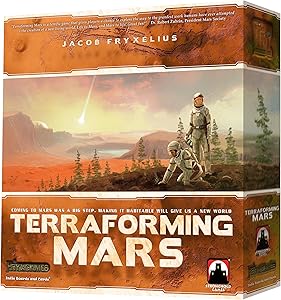
Terraforming Mars remains one of the best strategy games to play in 2026 if you want something that scales from casual to completely absurd complexity. You're managing a corporation tasked with making Mars habitable, which means you're collecting resources, playing cards that synergize with each other, and trying to trigger a chain reaction of powers.
This is engine building at its finest. Early game, you're establishing your resource production. Mid-game, cards start triggering abilities and you're building combinations. Late game, you're watching your engine purr while other players scramble to keep up. A single card can completely change your trajectory if you've built toward it properly.
What I appreciate about this is how your corporation's unique ability genuinely changes how you approach the game. You can play it competitively (racing to terraform Mars fastest) or semi-cooperatively (just building the coolest engine). With 1-5 players, it accommodates solo play beautifully. That flexibility is rare.
The downside? With 5 players, turns can drag. There's also a lot of random card draw involved—sometimes your strategy depends on getting the right cards at the right time. That's not a deal-breaker for most people, but if you want pure strategy, randomness might frustrate you.
Pros:
- Excellent solo mode if you want strategy games to play in 2026 without opponents
- Engine building is deeply satisfying when your combo pieces click
- Corporate abilities create meaningful differences between playthroughs
- Scales beautifully from 1 to 5 players
Cons:
- Card draw luck significantly impacts your options
- Can feel repetitive after 10+ plays without expansions
- Player elimination potential (you can fall too far behind)
- Setup and teardown takes genuine time
3. Gaia Project — Complex Space Strategy

If you want the best strategy game to play in 2026 that doesn't pull any punches on complexity, Gaia Project is calling your name. This is a 4X-style game (explore, expand, exploit, exterminate) built on a hexagonal board where you're navigating space with completely asymmetrical alien races. Each faction plays by different rules, builds different structures, and has unique advantages.
The map is randomized each game, which means you're constantly adapting your expansion strategy. You're managing multiple currencies (credits, knowledge, power, gaias), researching tech, building infrastructure, and managing relationships with other players. Advanced round cards change which actions are available each turn, adding puzzle-like depth.
Gaia Project is phenomenal if you like games where every faction feels like a different game. Playing as the Ivits (space nomads with no home planet) plays completely different from the Hadsch Hallas (economic powerhouses). This replayability is genuine—not just "different unit stats," but fundamentally different strategic approaches.
The learning curve is steep, though. You need to understand how five different factions approach the same board before you can make informed decisions. And with 2-4 players, game length scales from 90 minutes to 3+ hours depending on experience level.
Pros:
- Asymmetrical faction design creates unique strategic paths
- Map randomization ensures no two games feel the same
- Incredibly satisfying when you master a faction's strengths
- Player interaction through gaias and power dynamics feels earned
Cons:
- Steep learning curve—this isn't a game to pick up casually
- Setup complexity is significant
- Takes meaningful time to play (expect 2+ hours)
- Token management can feel fiddly with the amount of tracking
4. Imperium: Classics — Solo Strategy and Campaign Play
Imperium: Classics is genuinely one of the best strategy games to play in 2026 if you're playing solo. This is a deck-building game where you're commanding a civilization through history, but with a campaign structure that carries consequences across games. You can play individual battles, or you can run a full historical campaign where your choices matter.
The deck-building here isn't just shuffling cards—it's representing the actual capabilities and technologies your civilization develops. You're managing three separate card decks (military, technology, culture) and balancing between them. A military-heavy deck might win battles but fall behind culturally. This creates genuine strategic tension.
What makes Imperium special is the solo experience. The opposing AI (represented through card mechanics) is surprisingly . You're not playing against a dummy AI—you're genuinely trying to outmaneuver a system that adapts to what you're doing. And if you want to replay the campaign differently, your previous decisions shape the world, which is satisfying in ways most games don't attempt.
The multiplayer experience is fine but not the main draw. The game really shines when you're playing solo and engaging with the campaign narrative. If you want pure competitive multiplayer strategy, look elsewhere.
Pros:
- Solo campaign mode is genuinely engaging and well-designed
- Deck-building creates meaningful strategic decisions
- Campaign carries over between games in interesting ways
- Reasonable play time (30-45 minutes per game)
Cons:
- Multiplayer is functional but not the highlight
- Campaign mode takes commitment (multiple sessions)
- Card quality could be better at this price point
- Solo difficulty can spike unexpectedly
5. Undaunted: Normandy — Tactical Card-Driven Combat
Undaunted: Normandy is the best strategy game to play in 2026 if you want tactics without the 4-hour commitment. This is a two-player war game using cards instead of typical miniatures. You're commanding small unit groups, drawing cards that represent your troops and actions, and trying to control map objectives.
The brilliance is the simplicity. You draw cards to reveal what units you have available, then you position them on a modular board. Cards serve double duty—they're resources and they're your action economy. Managing your hand becomes a puzzle: do you play this card for its combat ability now, or hold it to play for its movement ability later?
The map tiles are randomized, so each scenario feels different. You can play through the included campaigns or mix scenarios. Play time is 30-60 minutes, which means you can actually get multiple games in an evening. The learning curve is gentle—explain it in 10 minutes and people are making informed decisions immediately.
The historical flavor is nice without being overwhelming. It feels like you're making tactical decisions rather than playing a history lesson. That balance is tricky and Undaunted nails it.
Pros:
- Elegant card-driven mechanic that's easy to learn
- Two-player focus means it's perfectly balanced for 1v1
- Reasonable play time (perfect for multiple sessions)
- Modular scenarios keep the game fresh
- Asymmetrical factions play completely differently
Cons:
- Strictly two-player (not flexible on player count)
- Randomized card draws can lead to unbalanced hands
- Scenarios can feel samey after 10+ plays
- Requires commitment to campaign for full experience
How I Chose These
I selected these five games based on what actually makes strategy games work in 2026. First, I weighted games where your decisions meaningfully impact outcomes—luck shouldn't overshadow strategy, though some randomness is fine. Second, I looked for games with different strategic appeals: economic (Brass), engine-building (Terraforming Mars), asymmetry (Gaia Project), campaign storytelling (Imperium), and tactical combat (Undaunted). Third, I considered player count flexibility and time commitments, because not everyone wants to invest 3 hours. Finally, I only included games that have proven staying power—these are genuinely played regularly in 2026, not flavor-of-the-month releases.
I intentionally left out games that require expansions to feel complete, games with severe balance issues, and games where you're watching others play more than playing yourself.
Frequently Asked Questions
What's the best strategy game to play in 2026 if I only have 30 minutes?
Undaunted: Normandy fits nicely into that window. Most games finish in 45-60 minutes, but you can play tighter. Imperium: Classics can also work if you're not doing a full campaign scenario.
Which of these best strategy games to play in 2026 works best solo?
Terraforming Mars and Imperium: Classics both have excellent solo modes. Terraforming Mars is more open-ended (you're just trying to engine-build efficiently), while Imperium has an actual campaign system. Choose based on whether you want "paint your own adventure" or "guided story."
Can I play these strategy games to play in 2026 with non-gamers?
Brass: Birmingham and Gaia Project are probably too heavy for casual players. Terraforming Mars works if people like theme. Undaunted is surprisingly approachable despite the military theme. Imperium depends on the scenario—solo campaign is fine, but multiplayer can overwhelm new players.
Which one should I buy first?
Start with Undaunted: Normandy if you want quick decisions and tactical thinking. Pick Terraforming Mars if you want to build something cool over 60-90 minutes. Go Brass: Birmingham if you want to outwit opponents through planning and positioning. These three are the most universally appealing of the best strategy games to play in 2026.
How do these compare to older strategy classics like Agricola or Puerto Rico?
These five games modernize strategic board gaming. They have better production quality, cleaner rulesets, and more interesting themes. Brass: Birmingham is actually a spiritual successor to Puerto Rico and improves on that formula. Gaia Project updates concepts from older 4X games. If you enjoyed those classics, you'll appreciate these upgrades.
---
Finding the best strategy game to play in 2026 really depends on what kind of decisions excite you. If you want economic depth, Brass: Birmingham is unbeatable. For building game-winning engine combinations, Terraforming Mars delivers. Need asymmetrical space opera complexity? Gaia Project is waiting. Want solo campaigns? Imperium: Classics has you covered. Prefer quick tactical decisions? Undaunted: Normandy is your answer. Pick based on what you actually want from your gaming sessions, and you won't be disappointed.
Get the best board game picks in your inbox
New reviews, top picks, and honest recommendations. No spam, unsubscribe anytime.
More in Strategy
The Best Engine Building Games of 2026: 5 Excellent Choices That Actually Deliver
Engine building games are genuinely addictive because they give you that satisfying progression feeling—you start with almost nothing, then gradually...
Best Euro Games for Kids in 2026: Top Picks for Family Game Night
Euro games—those elegant, strategy-focused board games from European designers—are perfect for kids who want more than dice-rolling luck.
The Best Euro Games Ever in 2026: Complete Reviews of Top Strategy Picks
If you're searching for the best euro games ever, you probably already know that euros are different from your typical American board games.