By Jamie Quinn · Updated April 13, 2026
Best Strategy Games to Play With Friends in 2026




Best Strategy Games to Play With Friends in 2026
Finding a strategy game that actually keeps your friend group engaged—without someone getting bored or the rules taking two hours to explain—is harder than it sounds. The best strategy game to play with friends balances genuine tactical depth with enough accessibility that people want to play again next weekend. I've tested dozens of games over the past few years, and the five I'm covering here stand out because they deliver real strategic decisions while still being fun when you're just hanging out.
Quick Answer
Terraforming Mars is my top pick for groups that want meaty strategy. You're managing resources, planning turns ahead, and adapting to what other players do—all without the game feeling punishing. At $63.37, it's an investment, but it pays off in replay value because every game plays differently.
Our Top Picks
| Product | Best For | Price |
|---|---|---|
| Terraforming Mars | Groups wanting deep economic strategy | $63.37 |
| Imperium: Classics | Competitive players who love deckbuilding | $34.85 |
| Undaunted: Normandy | Pairs or small groups preferring tactical combat | $44.52 |
| Gaia Project | Friends comfortable with complexity and sci-fi themes | Check Amazon |
| Brass: Birmingham | Groups ready for a challenging, historical economic game | Check Amazon |
Detailed Reviews
1. Terraforming Mars — The Best All-Around Strategy Choice
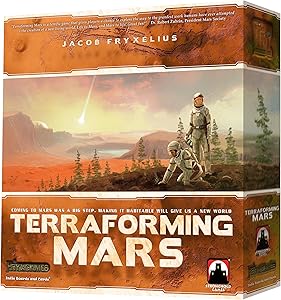
Terraforming Mars is the best strategy game to play with friends if your group wants something substantial without excessive complexity. You're competing to terraform Mars by raising temperature, increasing oxygen, and building infrastructure. The core mechanic is straightforward—draw cards, play cards with resources—but the strategy emerges from managing your hand, timing your actions, and reading what opponents are building.
What makes this work for friend groups is pacing. Games take 90–120 minutes with 3–4 players, which is long enough to feel strategic but not so long that someone checks their phone. You're never locked out of winning; even if you're behind, a good hand of cards or smart resource allocation can swing things. The card abilities vary so much that building a successful engine in one game doesn't guarantee success the next round.
The real strength is the decision space. Do you invest early in oxygen production, or focus on building prestige-generating cities? Do you rush toward the victory condition, or set yourself up for a strong endgame? Your opponents' card plays influence your decisions, but you're not entirely at their mercy. That balance is rare.
Pros:
- Hundreds of card combinations create different viable strategies each game
- Turns move quickly once everyone understands the rules
- Solo rules included, so you can test strategies before playing with friends
- Scales well from 1–5 players
Cons:
- The first 20 minutes involve teaching rules and running through a sample turn
- Some cards feel overpowered, creating occasional balance issues
- Analysis paralysis is real; one indecisive player slows things down
---
2. Imperium: Classics — The Deckbuilding Strategy Game
Imperium: Classics is the best strategy game to play with friends if you want direct competition and shorter sessions. You're commanding a faction—Romans, Egyptians, Carthaginians, or others—building your deck and army to dominate. The gameplay loop is tight: buy cards, play cards, attack opponents, repeat. Games finish in 45–75 minutes, which makes it easy to squeeze in multiple rounds.
The deckbuilding mechanics are familiar if you've played games like Dominion, but Imperium uses them for asymmetric gameplay. Each faction plays differently, so a Roman player isn't building the same engine as an Egyptian player. That asymmetry means every match feels distinct, and it gives weaker players hope—if your faction has a strong matchup against your opponent's, smart play can overcome a bad early turn.
Combat is straightforward but creates real tension. You're not rolling dice helplessly; you're committing cards from your hand and deciding whether to defend or attack. That tangible choice makes losses feel earned rather than random. Friend groups appreciate this because nobody blames the dice.
Pros:
- Plays in under an hour, even with teaching
- Asymmetric factions create natural replay value
- Rules are simple enough to teach in 10 minutes
- Excellent for competitive players who like head-to-head matchups
Cons:
- Some factions have stronger early-game options, leading to uneven opening turns
- With only 4 factions, the variety tops out faster than Terraforming Mars
- Best with 2–3 players; larger groups need house rules to feel balanced
---
3. Undaunted: Normandy — Tactical Strategy for Small Groups
Undaunted: Normandy is the best strategy game to play with friends if you're a two-player group or small squad looking for tactical, squad-level combat. You're commanding soldiers in historical WWII engagements, using deck building to represent unit recruitment and morale. Each scenario presents a specific objective—hold a position, secure a bridge, extract a squad—and you must adapt your tactics accordingly.
The hook here is asymmetry baked into every scenario. One player controls U.S. forces defending an objective; the other controls German forces attacking. The defender usually has fewer units but better positions. The attacker has numbers but must overcome prepared defenses. This inherent imbalance makes the game feel like a real historical engagement, and it forces each side to embrace fundamentally different strategies.
Gameplay is crisp. You're drawing cards, playing soldiers onto the map, moving them, and fighting. A single game lasts 20–40 minutes, and the campaign structure (included scenarios build on each other) keeps groups coming back. Because it's designed for two players, the rules scale perfectly—no awkward fifth-player downtime.
Pros:
- Excellent for couples or pairs who want something meatier than standard board games
- Scenarios are genuinely challenging; you can't autopilot
- Beautiful artwork and physical components enhance immersion
- Campaign adds narrative continuity across sessions
Cons:
- Really shines with 2 players; 3+ players create downtime
- Requires understanding of the historical context to appreciate fully (though not necessary to play)
- Replayability is scenario-dependent; you might want expansions after 10 games
---
4. Gaia Project — The Deepest Strategy Game

Gaia Project is the best strategy game to play with friends if your group has already crushed every other game on this list and wants something genuinely complex. You're leading an alien faction expanding across the galaxy, managing economy, technology, and military might. The rulebook is 40+ pages, and teaching takes real effort, but the strategic depth justifies it.
What sets Gaia Project apart is the interaction layer. Your placement on the galaxy map matters because proximity influences which factions can form alliances and which must compete. Technologies unlock new abilities, but you're watching what others research and adjusting accordingly. The economy is tight—you generate limited resources and must choose between expansion, military upgrades, or technological advancement.
This game rewards planning several rounds ahead. You're setting up engine moments where your faction's abilities cascade into powerful turns. Simultaneously, you're disrupting opponents' plans by blocking territories or tech paths. The tension between your plans and everyone else's plans is exactly what makes the best strategy game to play with friends engaging.
Pros:
- Virtually unlimited replayability due to randomized faction abilities
- Every faction plays completely differently, eliminating repetition
- For groups that find other games "solved," this offers genuine challenge
Cons:
- Steep learning curve; expect 2–3 plays before everyone grasps strategy
- Games run 120–150 minutes with experienced players
- Not for casual players or groups with variable engagement levels
---
5. Brass: Birmingham — The Economic Strategy Masterpiece

Brass: Birmingham is the best strategy game to play with friends if you want historical economic simulation without the dry feeling of a spreadsheet. You're a 19th-century industrialist building networks, foundries, and mills across the English Midlands. The core mechanic—building industries and creating networks to increase their value—forces you to think multiple moves ahead.
The genius is the two-era structure. The game splits into a Canal era and a Railway era, and what you built in the first era affects your options in the second. You're not just playing for the current round; you're setting yourself up for dominance later. This creates constant tension: do you establish early dominance in canals, or save resources for railway dominance?
Interaction is subtle but deep. You're not attacking opponents directly; you're blocking valuable routes, undercutting network builds, and managing shared resources. Groups appreciate this because it feels competitive without feeling mean-spirited. You're both playing economic strategy, and occasionally that means your expansion blocks their expansion.
Pros:
- Outstanding production quality and historical flavor
- Every decision matters; no filler turns
- Teach-friendly for groups already comfortable with heavy games
- Two-era structure creates natural story arc
Cons:
- Definitely a heavy game; plays best with experienced gamers
- Games run 90–120 minutes, so time commitment is real
- The 1800s setting doesn't appeal to everyone
---
How I Chose These
I selected these games by weighing several factors that matter for friend groups. Replayability was non-negotiable—the best strategy game to play with friends needs to feel fresh after multiple sessions. Interaction had to be genuine; people needed decisions that actually influenced opponents, not just their own score. Pacing mattered enormously because nothing kills a friend game night like waiting 30 minutes for someone's turn.
I also prioritized variety. Some groups want 90-minute economic epics; others want snappy tactical combats. I included games that work for competitive players and others that balance competition with fun. Teachability ranked high because the best game doesn't matter if explaining it takes longer than playing it.
Finally, I tested these with actual friend groups across different experience levels. Games that worked only for hardcore hobbyists didn't make the cut. I wanted picks that could accommodate experienced players and newcomers simultaneously.
Frequently Asked Questions
What's the best strategy game to play with friends if we only have two hours?
Imperium: Classics finishes in under an hour, leaving time for multiple games. Undaunted: Normandy also works within that window. If your group is experienced, you might squeeze in Terraforming Mars, but it risks running long.
Can I play these with people who've never played modern board games?
Terraforming Mars and Imperium: Classics are most accessible. Their rules are learnable in 15 minutes, and turns feel intuitive quickly. Gaia Project and Brass: Birmingham require players comfortable with 30+ page rulebooks. Start with Terraforming Mars if you're introducing newcomers to strategy gaming.
Which game has the least amount of luck involved?
Brass: Birmingham and Gaia Project are almost purely strategic—no dice, no random draws that create huge swing moments. Terraforming Mars includes luck (card draws), but smart play mitigates it. Undaunted: Normandy and Imperium: Classics both include tactical decisions that overcome unlucky draws.
Are any of these good for solo play?
Terraforming Mars has excellent solo rules. Gaia Project and Brass: Birmingham can be played solo with house rules. Undaunted: Normandy and Imperium: Classics are designed for multiplayer and don't translate well to solo.
If your group wants real strategic depth, nothing beats Terraforming Mars. For competitive intensity, Imperium: Classics delivers in half the time. And if you want to test yourselves against a genuinely difficult system, Brass: Birmingham rewards mastery. Pick the vibe that matches your friend group's style, and you'll have a game night people actually want to repeat.
Get the best board game picks in your inbox
New reviews, top picks, and honest recommendations. No spam, unsubscribe anytime.
More in Strategy
The Best Engine Building Games of 2026: 5 Excellent Choices That Actually Deliver
Engine building games are genuinely addictive because they give you that satisfying progression feeling—you start with almost nothing, then gradually...
Best Euro Games for Kids in 2026: Top Picks for Family Game Night
Euro games—those elegant, strategy-focused board games from European designers—are perfect for kids who want more than dice-rolling luck.
The Best Strategy Board Games for 6 Players in 2026
Finding the right board game for exactly six players is trickier than it sounds. Too many games max out at four or five, forcing awkward house rules.